
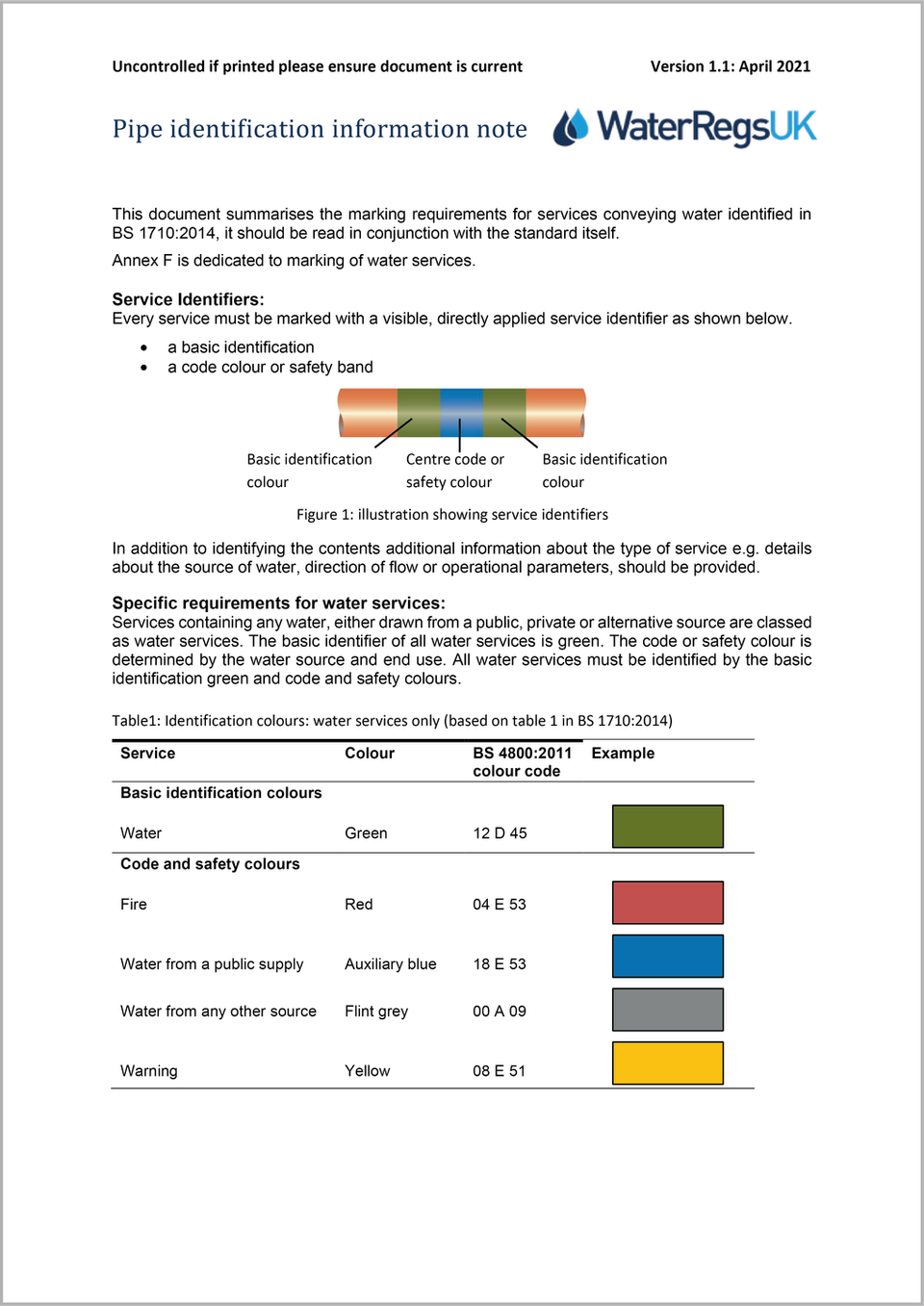
Irrespective of what fluid is being conveyed all pipework, whether installed above or below ground, should be marked in accordance with the latest version of BS 1710.
To identify what parts of a plumbing system they control, servicing valves should be labelled.
For further information please refer to the pipe identification information leaflet
To improve this information please give us your feedback >
Uncontrolled if downloaded. This is informative, non-statutory guidance and intended for general guidance purposes only; it is subject to change.
Compliance with this information should not be relied upon as guaranteeing no enforcement action will be taken by water undertakers. Water Regs UK accepts no liability for loss, indirect or consequential loss arising from or in connection with this guidance document.
Alternative water supplies should never be directly connected to the mains drinking water and owners/occupiers should always ensure the local water undertaker is aware if a premises has both a mains drinking water and alternative water supply, such as a borehole or rainwater.
Where mains water and other water sources, such as rainwater, recycled water, river water and borehole supplies, combine it is essential to notify the relevant water undertaker to ensure adequate backflow protection arrangements are installed.
The only legal and safe way to combine mains and another source of water is to use an arrangement called a break tank which enables separation of supplies. Typically, this is done using a Type AA or Type AB air gap the key features being:
An unrestricted or weir spill over
The pipework supplying the mains water must be external to the tank
The mains water feed must discharge at a higher level than and maintain a minimum clearance (twice the internal diameter (2D) of the supply pipework or 20 mm whichever is the greater) from those another sources
The water in the tank should not come into contact with the mains water inlet for example as a result of splashing.
To improve this information please give us your feedback >
Uncontrolled if downloaded. This is informative, non-statutory guidance and intended for general guidance purposes only; it is subject to change.
Compliance with this information should not be relied upon as guaranteeing no enforcement action will be taken by water undertakers. Water Regs UK accepts no liability for loss, indirect or consequential loss arising from or in connection with this guidance document.
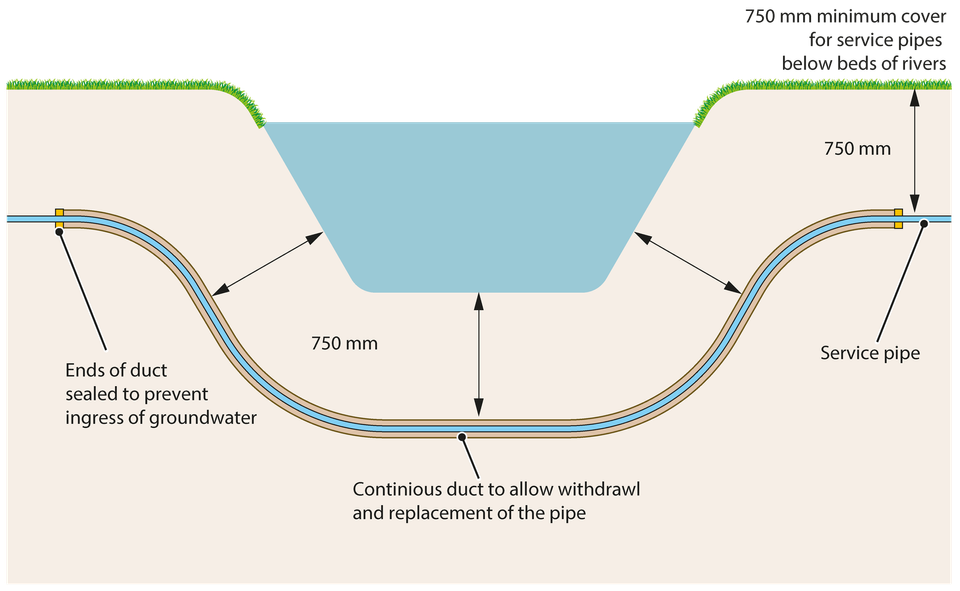
Sometimes pipework will need to cross a natural or manmade water course such as a stream or ditch. Where this is necessary an example of one method of installation, which a water undertaker may be willing to agree to is shown below.
To improve this information please give us your feedback >
Uncontrolled if downloaded. This is informative, non-statutory guidance and intended for general guidance purposes only; it is subject to change.
Compliance with this information should not be relied upon as guaranteeing no enforcement action will be taken by water undertakers. Water Regs UK accepts no liability for loss, indirect or consequential loss arising from or in connection with this guidance document.
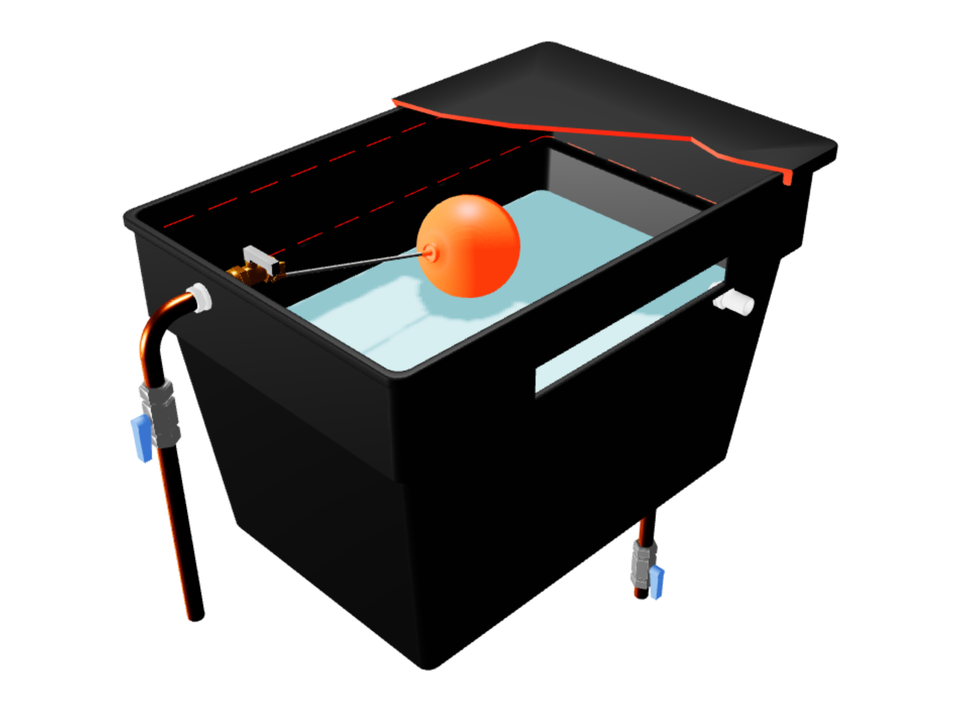
A Type AB air gap is a non-mechanical backflow prevention arrangement comprising of an inlet which discharges water into a cistern, vessel, fitting or appliance (receiving vessel) fitted with an outlet and a rectangular weir or ‘slot’ overflow. Depending on the outcome of an assessment by the local water undertaker it can feed a single or multiple installations.
A Type AB air gap is rated by the Regulators as suitable backflow protection against both back siphonage and back pressure at the highest level of contamination risk, fluid category 5.
A summary of some of the key requirements applicable to a Type AB air gap is given below:
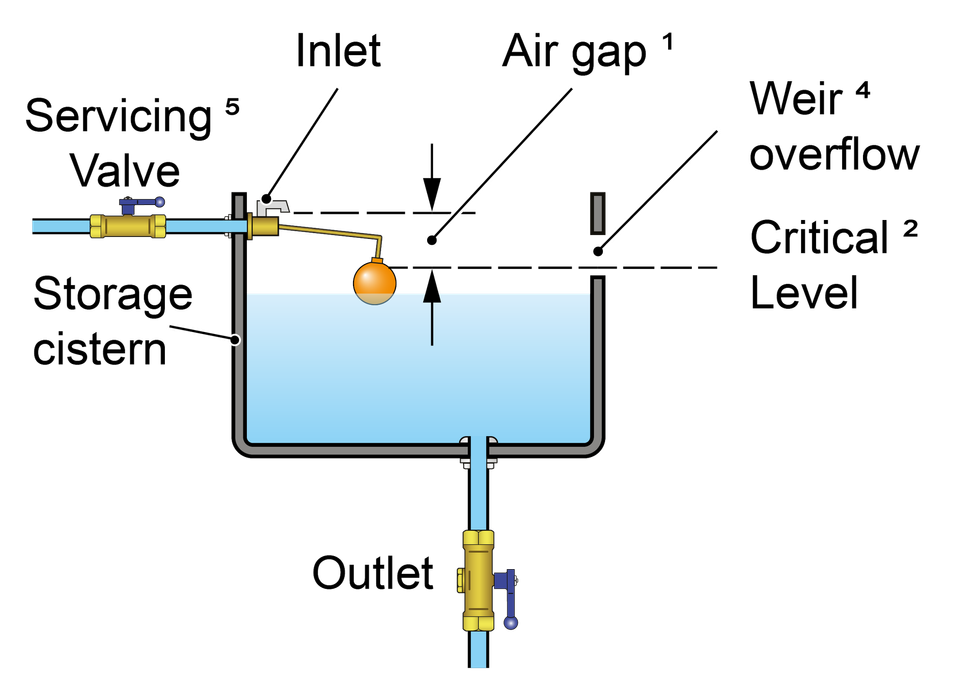
The air gap is an unobstructed and complete physical break between the lowest point of discharge and the critical water level of the weir overflow. Measured vertically it must be no less than 20 mm or twice the internal diameter of the supply whichever is the greater.
The critical level (sometimes referred to as h) is the fluid level in the receiving vessel under fault conditions i.e. when the outlet is closed but the inlet continues to discharge. It is measured at least 2 seconds after closing the water inlet
Whether sited internally or externally (as shown in the diagram opposite) the weir overflow must be rectangular (non-circular) and capable of accommodating discharge under fault conditions. Where a screened mesh is installed consideration should be given to the impact this may have on discharge flow.
The air gap can be confirmed by test or calculation. A guide for sizing can be found in publications.
Neither the fluid pathway to the overflow nor the discharge from it should be restricted. For example, there should be a sufficient gap between the overflow and any surface to accommodate full discharge unimpeded during fault conditions.
Submerged supply pipes are not permitted. If the supply pipe feeding the inlet or the inlet itself comes into contact with the contents of the receiving vessel, for example due to splashing or foaming, then the air gap is considered to be compromised and must be increased to the point no contact occurs.
Type AB air gap installations, including screened mesh, should be inspected, cleaned and as necessary maintained every 6 months (BS EN 806: 5)

To improve this information please give us your feedback >
Uncontrolled if downloaded. This is informative, non-statutory guidance and intended for general guidance purposes only; it is subject to change.
Compliance with this information should not be relied upon as guaranteeing no enforcement action will be taken by water undertakers. Water Regs UK accepts no liability for loss, indirect or consequential loss arising from or in connection with this guidance document.
We use cookies to give you the best possible experience with Water Regs UK. Some are essential to provide website functions and ensure the website is secure. We also use cookies to help us understand how people use the site and to make improvements. Click "Accept All" to enable recommended settings or click "Manage cookies" to adjust your settings. For more details, see our Cookie Policy.