

Types of systems
Hot water systems supplying heating are referred to as primary circuits, those supplying hot water secondary circuits.
Hot water systems heating both the primary and secondary circuits are typically either vented or unvented.
Small appliances which only heat hot water for localised use are typically referred to as instantaneous or independent water heaters.
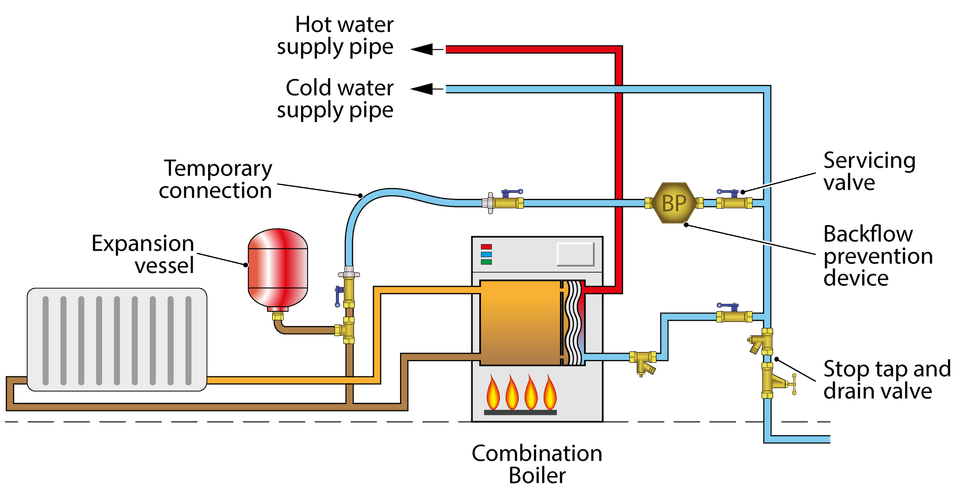
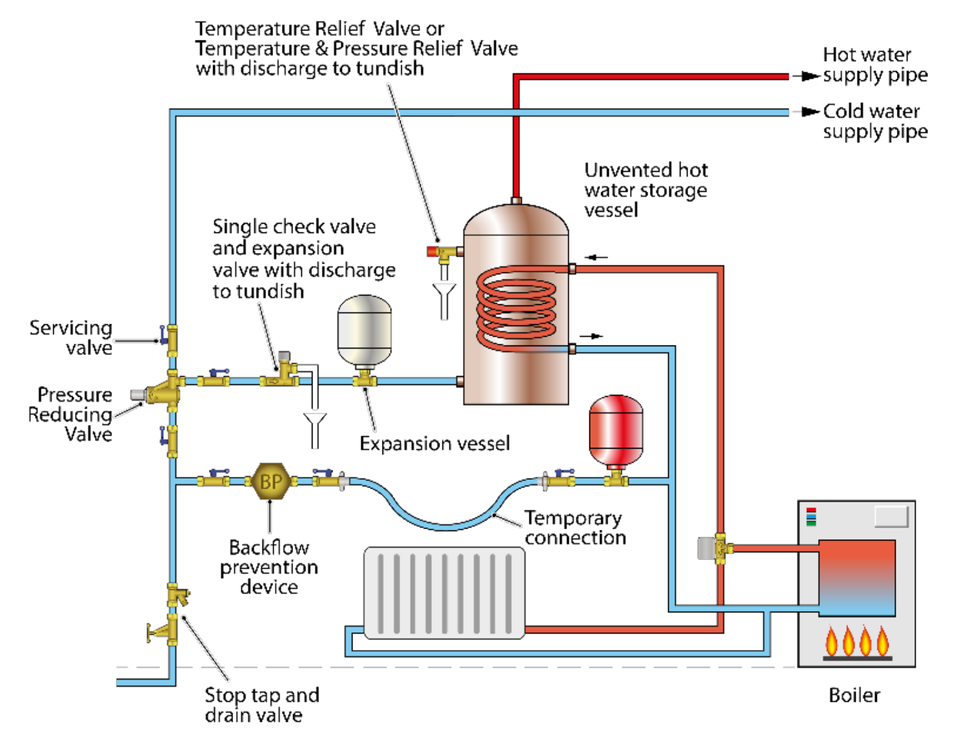
Colour code key:
Orange: primary circuit
Red: secondary circuit
Blue: cold water
(For illustration purposes only)
The FAQs listed opposite include lots of useful information but some of the key points are:
All hot water and heating systems must be able to accommodate thermal expansion. There are specific requirements for safety devices link
Please note: In addition to the water fittings regulations/byelaws consideration should also be given to Building Regulations requirements.
Limited thermal expansion within cold water pipework is only allowed in specific circumstances link.
Expansion vessel these must be installed correctly link.
No hot water or heating system can be connected directly to waste. Separation is typically achieved by installing an acceptable tundish arrangement or compliant air break to drain link.
Unvented systems sometimes need to be ‘topped up’. How this is done depends upon the risk posed by the contents of the system link.
Guidance to relevant requirements includes:
Good system design, commissioning and maintenance will help to reduce and address the risk of contamination resulting from microbial growth and limit waste due to taps left to run.
Storage and distribution temperature requirement for domestic hot water systems are set out in other legislation, codes of practice and British Standards.
For further information please refer to Building Regulations, BS EN 806, BS 8558, HSC L8 and CIBSE Commissioning Code M.
The risk is dependent upon the fluid, for example, the dose used and concentration of inhibitors within the system. The volume of fluids and operating pressures will also be considered when assessing the suitability of the backflow protection device or arrangement to be installed.
Please note the final decision rests with the local water undertaker.
Yes, appropriate separation is required. Minimising the risk of contaminated fluids coming into contact with water to be used for domestic purposes (drinking, bathing, washing, cooking etc) is a key objective of the water fittings regulations/byelaws.
Mindful of the need to ensure sufficient safeguards are in place to address the possibility of drinking water supplies coming into contact with fluids which are not considered to be wholesome, in determining whether systems making use of heat recovery or exchange are compliant with regulation 4(1) the following factors will be taken into consideration. Please note decisions will be taken on a case by case basis.
The actual fluid categories of the fluids within the system.
How readily identifiable any potential integrity failure of the system would be.
Whether the system design meets the requirements for single or double wall separation specified in BS EN 1717.
All safety devices must comply with the requirements of regulation/byelaw 4(1). Examples of appropriate British Standards are given in the guidance to part G of the Building Regulations.
Any discharge from a hot water system safety device should be safe and conspicuous. Where a discharge is made via a tundish it should conform to the applicable British Standard or equivalent. For further information please refer to the relevant version of the Building Regulations.
Where a closed circuit (heating system etc) has been categorised by the water undertaker as a fluid category 3 risk, the installation of a compliant double check valve on the fill point connection to the supply/distribution pipe may be considered as acceptable backflow protection.
Where a fill point connection incorporates a “flexible hose connection”, when not in use it is good practice for the hose to be completely disconnected and removed. However, a partial disconnection, that is to say only detaching one end of the hose, may be acceptable providing the disconnection is made between the hose and the backflow prevention device on the supply/distribution pipe.
Please note: if the water undertaker has concerns about the likelihood of contamination, or the suitability of a double check valve - for example due either to age, operating temperature or pressure fluctuations – under schedule 2 paragraph 15(4) they can require the installation of additional backflow protection.
Advice regarding the sizing of hot water system vent pipes can be found in the guidance to part G of the Building Regulations, BS EN 806 and BS 8558.
Regulations & Byelaws which apply include but are not limited to:
Relevant guidance includes but is not limited to:
Uncontrolled if downloaded. This is informative, non-statutory guidance and intended for general guidance purposes only; it is subject to change.
Compliance with this information should not be relied upon as guaranteeing no enforcement action will be taken by water undertakers. Water Regs UK accepts no liability for loss, indirect or consequential loss arising from or in connection with this guidance document.
We use cookies to give you the best possible experience with Water Regs UK. Some are essential to provide website functions and ensure the website is secure. We also use cookies to help us understand how people use the site and to make improvements. Click "Accept All" to enable recommended settings or click "Manage cookies" to adjust your settings. For more details, see our Cookie Policy.