
This is evidence to show a water fitting is of an appropriate quality and standard for installation.
Water undertakers will consider evidence of compliance provided on a case and site specific basis.
Whilst this evidence must satisfy another regulation/byelaw [4(2)], water undertakers have no preference for, or require it to be in a specific form. Typically, they will consider declarations of performance issued against designated standards, product certification and test reports.
Please note:
Because a water fitting must comply with all parts of the regulations being of an appropriate quality and standard does not, of itself, guarantee compliance with the regulations.
The latest available edition or version of guidance or specifications should always be used.
In respect of equivalence water undertaker retain absolute discretion in assessing whether a national specification provides an equivalent level of protection and performance to that specified in an appropriate British Standard. For information regarding the equivalence of a performance specification please contact your water undertaker.
For further information please refer to Regulation 4(1)(a) compliance guidance and BS 6920 Compliance Overview.
Any questions please contact the local water undertaker for advice.
To improve this information please give us your feedback >
Uncontrolled if downloaded. This is informative, non-statutory guidance and intended for general guidance purposes only; it is subject to change.
Compliance with this information should not be relied upon as guaranteeing no enforcement action will be taken by water undertakers. Water Regs UK accepts no liability for loss, indirect or consequential loss arising from or in connection with this guidance document.
Not necessarily. Product certification, whether it be under the Construction Products Regulations or by a product certification scheme, demonstrate a product conforms to either an appropriate British Standard* or the Regulators Specification for fittings and is therefore of an appropriate quality and standard.
However, this is only one requirement of the water fittings regulations, byelaws. When installed there will be others all of which have to be satisfied. Therefore, in isolation certification cannot be relied upon to guarantee compliance as where and how it will be installed and used is unknown.
Please note some schemes provide helpful installation advice this may highlight installation requirements likely to apply, but this might not be the case in all circumstances. The suitability of an installation is determined by the local water undertaker, who retains absolute discretion in assessing whether an installation is compliant.
For further information please refer to Regulation 4(1)(a) compliance guidance and BS 6920 Compliance Overview.
Any questions please contact the local water undertaker for advice.
*National specifications from other countries will be considered providing they provide an equivalent level of protection and performance
To improve this information please give us your feedback >
Uncontrolled if downloaded. This is informative, non-statutory guidance and intended for general guidance purposes only; it is subject to change.
Compliance with this information should not be relied upon as guaranteeing no enforcement action will be taken by water undertakers. Water Regs UK accepts no liability for loss, indirect or consequential loss arising from or in connection with this guidance document.
Establishing whether a water fitting is suitable for installation is dependent upon a number of factors including but not limited to:
Water fittings must be of an appropriate quality and standard
System design, things considered include but are not limited to compatibility:
with other water fittings within a plumbing system (e.g the potential for galvanic action)
system operational parameters (e.g. the maximum* and minimum pressure, temperature and flow the systems will be operating at)
Location specific factors, things considered include but are not limited to:
the environment (e.g. ground or airborne contamination, the risk of frost damage, corrosion or dezincification)
product installation requirements and/or constraints (e.g. installed where light is excluded or only above ground)
installation backflow risks (e.g. the need for backflow protection to be installed)
Requirements of schedule 2 as applicable.
If the proposed plumbing work is notifiable, the suitability of water fittings will be assessed as part of the notification process.
If the installation is not notifiable there remains a legal obligation for the installer and premises owner or occupier to ensure the plumbing work is fully compliant with the water fittings regulations in England, Wales and Northern Ireland, byelaws in Scotland. Therefore, if in doubt, contact the local water undertaker for advice.
*Please note all water fittings must be capable of withstanding an internal water pressure of not less than 1½ times the maximum pressure it will be subject to in operation.
To improve this information please give us your feedback >
Uncontrolled if downloaded. This is informative, non-statutory guidance and intended for general guidance purposes only; it is subject to change.
Compliance with this information should not be relied upon as guaranteeing no enforcement action will be taken by water undertakers. Water Regs UK accepts no liability for loss, indirect or consequential loss arising from or in connection with this guidance document.
No, the installation of lead water fittings, including solder, has been prohibited for many decades.
Further information about lead in drinking water be found using the links below:
If you have an existing lead plumbing system and have any questions, contact your local water undertaker.
To improve this information please give us your feedback >
Uncontrolled if downloaded. This is informative, non-statutory guidance and intended for general guidance purposes only; it is subject to change.
Compliance with this information should not be relied upon as guaranteeing no enforcement action will be taken by water undertakers. Water Regs UK accepts no liability for loss, indirect or consequential loss arising from or in connection with this guidance document.
The installation of new lead pipes and fittings has been prohibited for many decades.
Before the ban it was legal to install lead pipework and fittings. These do not have to be replaced unless there are concerns about the levels of lead in the drinking water or waste of water.
Further information about lead in drinking water be found using the links below:
If you have an existing lead plumbing system and have any questions, contact your local water undertaker.
To improve this information please give us your feedback >
Uncontrolled if downloaded. This is informative, non-statutory guidance and intended for general guidance purposes only; it is subject to change.
Compliance with this information should not be relied upon as guaranteeing no enforcement action will be taken by water undertakers. Water Regs UK accepts no liability for loss, indirect or consequential loss arising from or in connection with this guidance document.
The replacement of any lead pipes or fittings, including supply pipes, is encouraged.
It is permissible to make repairs to lead supply pipes which were legally installed providing compliant fittings and materials are used.
Consumers should be aware that repairs to lead pipes, especially those exposing the water to a freshly cut lead surface, may temporarily result in raised lead concentrations, and so should be flushed before use.
Further information about lead in drinking water be found using the links below:
If you have any questions about an existing lead plumbing system, contact your local water undertaker.
To improve this information please give us your feedback >
Uncontrolled if downloaded. This is informative, non-statutory guidance and intended for general guidance purposes only; it is subject to change.
Compliance with this information should not be relied upon as guaranteeing no enforcement action will be taken by water undertakers. Water Regs UK accepts no liability for loss, indirect or consequential loss arising from or in connection with this guidance document.
It is illegal to use on any plumbing systems supplying drinking water used for drinking, cooking, bathing, or washing (domestic purposes), but can be used in very limited applications such as closed heating circuits.
If you are having any plumbing work done, ask for lead free solder to be used. This will not only give peace of mind but also avoid the inconvenience and cost of rectification work resulting from the use of the wrong type of solder.
To improve this information please give us your feedback >
Uncontrolled if downloaded. This is informative, non-statutory guidance and intended for general guidance purposes only; it is subject to change.
Compliance with this information should not be relied upon as guaranteeing no enforcement action will be taken by water undertakers. Water Regs UK accepts no liability for loss, indirect or consequential loss arising from or in connection with this guidance document.
When designing a compliant plumbing system a number of factors need to be considered, including but not limited to:
Avoiding the risk of contamination or damage resulting from the environment in which the system is to be installed or due to the design itself.
The required and attainable supply pressure and other operational parameters
User expectations and whether these are achievable
Suitability of water fittings for use
Providing appropriate, adequate backflow protection.
Water efficiency
Limiting waste.
Useful sources of information include BS EN 806 and BS 8558
To improve this information please give us your feedback >
Uncontrolled if downloaded. This is informative, non-statutory guidance and intended for general guidance purposes only; it is subject to change.
Compliance with this information should not be relied upon as guaranteeing no enforcement action will be taken by water undertakers. Water Regs UK accepts no liability for loss, indirect or consequential loss arising from or in connection with this guidance document.
To minimise the risk of contamination resulting from microbial growth and wastage due to taps left to run, cold water storage and distribution systems should be designed and installed to maintain a temperature not exceeding 20oC.
Plumbing systems should be designed and installed to ensure there is regular flow through.
To prevent undue warming, it is good practice to insulate both hot and cold water pipework. Unless it is adequately protected water fittings should not be installed where it could be exposed to heat sources, such as other services or sunlight.
For further information please refer to BS EN 806, BS 8558 and HSE Legionella ACOP.
To improve this information please give us your feedback >
Uncontrolled if downloaded. This is informative, non-statutory guidance and intended for general guidance purposes only; it is subject to change.
Compliance with this information should not be relied upon as guaranteeing no enforcement action will be taken by water undertakers. Water Regs UK accepts no liability for loss, indirect or consequential loss arising from or in connection with this guidance document.
Alternative water supplies should never be directly connected to the mains drinking water and owners/occupiers should always ensure the local water undertaker is aware if a premises has both a mains drinking water and alternative water supply, such as a borehole or rainwater.
Where mains water and other water sources, such as rainwater, recycled water, river water and borehole supplies, combine it is essential to notify the relevant water undertaker to ensure adequate backflow protection arrangements are installed.
The only legal and safe way to combine mains and another source of water is to use an arrangement called a break tank which enables separation of supplies. Typically, this is done using a Type AA or Type AB air gap the key features being:
An unrestricted or weir spill over
The pipework supplying the mains water must be external to the tank
The mains water feed must discharge at a higher level than and maintain a minimum clearance (twice the internal diameter (2D) of the supply pipework or 20 mm whichever is the greater) from those another sources
The water in the tank should not come into contact with the mains water inlet for example as a result of splashing.
To improve this information please give us your feedback >
Uncontrolled if downloaded. This is informative, non-statutory guidance and intended for general guidance purposes only; it is subject to change.
Compliance with this information should not be relied upon as guaranteeing no enforcement action will be taken by water undertakers. Water Regs UK accepts no liability for loss, indirect or consequential loss arising from or in connection with this guidance document.

Where the water stored in a cistern has to remain wholesome, it is important to minimise the risk of contamination. Key to this is making sure the water is stored for as short a period as possible.
This is achieved through a combination of design and maintenance features, correctly sizing the cistern to ensure the regular turnover of the stored water and avoiding stagnation as well as any deterioration of water quality.
Factors which should be considered when sizing a cistern include occupancy (intended and actual) and usage. Suggestions for storage capacity are given in BS EN 806-2.
To improve this information please give us your feedback >
Uncontrolled if downloaded. This is informative, non-statutory guidance and intended for general guidance purposes only; it is subject to change.
Compliance with this information should not be relied upon as guaranteeing no enforcement action will be taken by water undertakers. Water Regs UK accepts no liability for loss, indirect or consequential loss arising from or in connection with this guidance document.
All components making up and used within a cold water storage cistern must be of an appropriate quality and standard
All non-metallic materials in contact with water, including any surface where condensate forms, must conform with the current version of BS 6920 (or an equivalent).
Cisterns should be watertight and where appropriate lined or coated with suitable impermeable materials.
In addition to an inlet, outlet, overflow pipe and warning arrangement a cistern should have a rigid close fitting and securely fixed lid or cover. Cisterns, and their lids, should be made of materials which do not shatter or fragment when broken.

To improve this information please give us your feedback >
Uncontrolled if downloaded. This is informative, non-statutory guidance and intended for general guidance purposes only; it is subject to change.
Compliance with this information should not be relied upon as guaranteeing no enforcement action will be taken by water undertakers. Water Regs UK accepts no liability for loss, indirect or consequential loss arising from or in connection with this guidance document.
An inlet valve must be fitted. This should be securely and rigidly fixed and must shut off the flow at a set level within the cistern. Typically, this level is a minimum of 25 mm below the overflow but should be increased to a minimum of 50 mm if there is no warning pipe. Where a float operated valve is to be used, this must be capable of being adjusted to ensure that the inlet valve closes at a defined level.
Where the inlet forms part of an air gap arrangement intended to prevent backflow, the inlet valve should not come into contact with the contents of the cistern as a result of splashing or foaming. If this occurs the inlet valve should be adjusted to increase the air gap.
Float operated valves are generally, but not always used for controlling the flow of water into a cistern. Electrically or pneumatically operated valves are also an acceptable form of valve for controlling the inlet flow. In all cases the method of installation must be suitable for the specific installation and comply with all aspects of the appropriate water fittings regulations/byelaws.
Transient pressure increases or surges (water hammer) may be caused by the rapid closure of valves, resulting in a sudden stop or change of water flow. To keep pressure surges within reasonable limits and prevent damage to water fittings hydro-pneumatic accumulators, surge arrestors or pressure reducing valve can be installed.
In addition to any backflow protection required by the local water undertaker a servicing valve must be installed on the inlet adjacent to the cistern and outlet to facilitate maintenance and minimise waste.
To encourage mixing and prevent areas of stagnation or ‘short circuiting’ within the cistern where practical the cistern inlet and outlet should be on opposite sides of an appropriately sized cistern. Where multiple cisterns are linked; inlets and outlets need to be carefully balanced to promote a good turnover of water in each cistern.
To improve this information please give us your feedback >
Uncontrolled if downloaded. This is informative, non-statutory guidance and intended for general guidance purposes only; it is subject to change.
Compliance with this information should not be relied upon as guaranteeing no enforcement action will be taken by water undertakers. Water Regs UK accepts no liability for loss, indirect or consequential loss arising from or in connection with this guidance document.
Where practicable all outlets from a storage cistern should be located at the bottom of the cistern and to encourage mixing and prevent areas of stagnation or ‘short circuiting’ within the cistern on the opposite side to the inlet.

All outlets from cold water storage cisterns, except vent pipes, overflow pipes and warning pipes, should be fitted with a servicing valve as close to the cistern as is reasonably practicable.
To improve this information please give us your feedback >
Uncontrolled if downloaded. This is informative, non-statutory guidance and intended for general guidance purposes only; it is subject to change.
Compliance with this information should not be relied upon as guaranteeing no enforcement action will be taken by water undertakers. Water Regs UK accepts no liability for loss, indirect or consequential loss arising from or in connection with this guidance document.
Every cold water storage cistern must be fitted with an overflow pipe.
To help minimise waste a suitable means of warning of an impending overflow must also be installed. A warning pipe is commonly used for this purpose, but with the local water undertaker’s agreement alternatives may be fitted. Although usually separate a combined overflow/warning pipe may be accepted on cisterns with a capacity of 1,000 litres or less.
Overflow and warning pipes must be positioned so as to exclude light and insects. A screen with a mesh size no greater than 0.65 mm (opening) is typically used to prevent the ingress of insects and other foreign bodies. If an insect screen is installed it should be vertically and removable.
Overflow and warning pipes should be installed on a downward inclined plane and not discharge into any other cistern.
The discharge from the overflow and/or warning pipe should be safe and conspicuous. If discharging to drain a visible air brake, giving fluid category 5 backflow protection in the form of an air break to drain conforming to the design specification given in EN 1717 must be installed.
If a common warning pipe is used the location of the cistern overflowing must be readily identifiable. A warning/overflow pipe should be at least 19 mm (internal diameter) and capable of accommodating all possible flow rates i.e. the maximum inflow under fault conditions. The effect of any screen on the nominal flow capacity must be taken into account when determining the size of an overflow.

To improve this information please give us your feedback >
Uncontrolled if downloaded. This is informative, non-statutory guidance and intended for general guidance purposes only; it is subject to change.
Compliance with this information should not be relied upon as guaranteeing no enforcement action will be taken by water undertakers. Water Regs UK accepts no liability for loss, indirect or consequential loss arising from or in connection with this guidance document.
A cold water storage cistern can sometime incorporate a Type AB air gap. Where this is the case it is important to minimise any light penetration through the weir overflow. This is because light is known to promote the growth of algae which could lead to not only taste and odour concerns but also provide nutrients which could support the growth of bacteria. The most common way of addressing this issue is to fit a cowl or shroud that covers the weir slot.
To demonstrate the cowl or shroud arrangement does not impede any discharge it should mirror the overflow weir in size and shape to at least below the lowest point of the weir and any surfaces below or to the side of the cistern as shown below. Information can also be found here
Please note: cold water storage cisterns incorporating a Type AB air gap are sometimes being used as backflow protection arrangements for high risk installation downstream and should not be removed or altered without the agreement of the local water undertaker.

To improve this information please give us your feedback >
Uncontrolled if downloaded. This is informative, non-statutory guidance and intended for general guidance purposes only; it is subject to change.
Compliance with this information should not be relied upon as guaranteeing no enforcement action will be taken by water undertakers. Water Regs UK accepts no liability for loss, indirect or consequential loss arising from or in connection with this guidance document.
Factors to consider when deciding where and how cold water storage cisterns are installed include but are not limited to:
whether the distributing pipework (system) is pumped or supplied by gravity
the need to allow for ease of access for maintenance
inspection (both internally and externally)
cleaning requirements
environmental factors which might affect water quality such as excessive heat gain or the likelihood of flooding.
Float operated valves and other controls should be readily accessible. There should be sufficient clearance to allow for inspection, cleaning of internal surfaces and maintenance.
Cisterns with a capacity greater than 1,000 litres should be capable of being inspected and cleansed without having to be wholly uncovered.
To avoid distortion cold water storage cisterns should be adequately supported. Advice on how to do this can be found in Part G of the Building Regulations.
Please note: In many cases the local water undertaker will need to be given advanced notice of the proposed installation of any cold water cistern. This is an important simple and essential check to minimise the risk to water supplies.
To improve this information please give us your feedback >
Uncontrolled if downloaded. This is informative, non-statutory guidance and intended for general guidance purposes only; it is subject to change.
Compliance with this information should not be relied upon as guaranteeing no enforcement action will be taken by water undertakers. Water Regs UK accepts no liability for loss, indirect or consequential loss arising from or in connection with this guidance document.
Due to concerns about water stagnation, which might cause the quality of the water to deteriorate, the installation of inter-linked storage cisterns should be avoided wherever possible.
Where it is unavoidable, the number of inter-linked cisterns should be minimised. To minimise the risk of stagnation:
The storage volume should be kept to a minimum
Cisterns should be connected in parallel
Any demand should create water flow throughout each cistern
Inlet and outlets should be installed at opposite ends of the cistern
Delayed action float valves should be used
Metering of inlets may assist with balancing of turnover

To improve this information please give us your feedback >
Uncontrolled if downloaded. This is informative, non-statutory guidance and intended for general guidance purposes only; it is subject to change.
Compliance with this information should not be relied upon as guaranteeing no enforcement action will be taken by water undertakers. Water Regs UK accepts no liability for loss, indirect or consequential loss arising from or in connection with this guidance document.
To minimise the risk of damage due to freezing and undue warming all cold water storage cisterns, including any associated pipework which may be at risk, should be sited away from heat sources and insulated. The type and level of insulation will be dependent on the environment in which the installation is located.
Undue warming is of concern for two reasons. It can potentially cause a deterioration of water quality and often result in customers leaving taps to run to waste.
Systems supplying cold water should be ideally designed to ensure that they distribute water at temperatures no greater than 20°C. This requirement may also apply under other legislation and code of practices, such as those relating to legionella control.

To improve this information please give us your feedback >
Uncontrolled if downloaded. This is informative, non-statutory guidance and intended for general guidance purposes only; it is subject to change.
Compliance with this information should not be relied upon as guaranteeing no enforcement action will be taken by water undertakers. Water Regs UK accepts no liability for loss, indirect or consequential loss arising from or in connection with this guidance document.
When water freezes it expands, meaning any water fitting subjected to freezing temperatures is at risk of fracturing, causing damage to property and a waste of water. To help prevent this it is essential any plumbing installation which might be exposed to cold conditions, including pipework which is laid shallower than 750 mm deep, are adequately protected. Typically by using insulation materials or trace heating.
Heat gain can also be an issue. Exposure to sunlight and proximity to heat sources can lead to undue warming of cold water, which can often result in taste or water quality issues and customers leaving taps to run. The correct level of insulation should prevent water temperatures exceeding 20°C.
The acceptability of the methods of protection is dependent on a number of location specific factors, such as the type and size of water fitting, the likely water supply and air temperatures as well as demand flow. Manufacturers usually provide information about the appropriate thickness and thermal conductivity in their technical specifications. BS EN ISO 12241 and BS 5422 are another source of useful information.
Any systems not used during cold weather, such as seasonal irrigation systems should be isolated and drained down. Similarly, if a premises is to be left unoccupied and unheated during cold weather, for example a holiday home or caravan, the water supply should be turned off and plumbing system drained.
When installed in accordance with the manufacturer’s instructions insulation may delay but not prevent freezing.
To improve this information please give us your feedback >
Uncontrolled if downloaded. This is informative, non-statutory guidance and intended for general guidance purposes only; it is subject to change.
Compliance with this information should not be relied upon as guaranteeing no enforcement action will be taken by water undertakers. Water Regs UK accepts no liability for loss, indirect or consequential loss arising from or in connection with this guidance document.
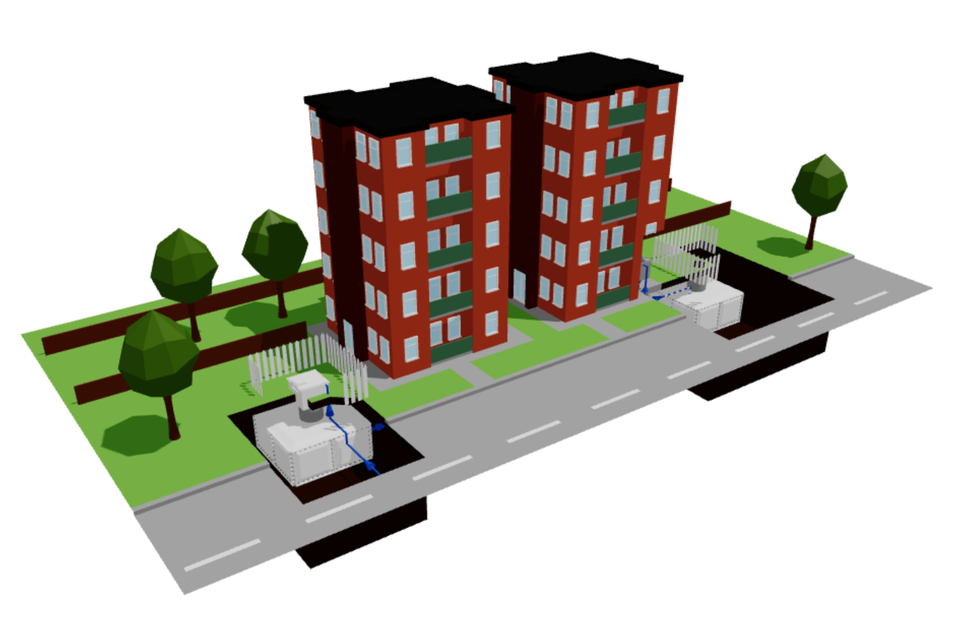
Information on installing underground water storage which is
Supplied directly from mains
Installed below ground level, wholly or partially outside the thermal envelope
can be found in the Underground Storage Guidance booklet
The image below is to be used in conjunction with this document.
To improve this information please give us your feedback >
Uncontrolled if downloaded. This is informative, non-statutory guidance and intended for general guidance purposes only; it is subject to change.
Compliance with this information should not be relied upon as guaranteeing no enforcement action will be taken by water undertakers. Water Regs UK accepts no liability for loss, indirect or consequential loss arising from or in connection with this guidance document.
Water softeners and conditioners are installed to change the characteristics of mains drinking water and must be maintained in accordance with the manufacturer’s instructions.
It is a legal requirement that any water used for drinking, cooking, bathing, or washing (domestic purposes) satisfy water quality standards i.e. be wholesome.
If a water softener or conditioner is installed ideally a drinking water tap supplying untreated should be retained. However, whole systems may be treated but on condition the treated water remains wholesome.
Where a water conditioner is certified or approved by a product certification scheme, if there is any mention of a likelihood of substances leaching into the water, it should not be used to treat whole premises.
To improve this information please give us your feedback >
Uncontrolled if downloaded. This is informative, non-statutory guidance and intended for general guidance purposes only; it is subject to change.
Compliance with this information should not be relied upon as guaranteeing no enforcement action will be taken by water undertakers. Water Regs UK accepts no liability for loss, indirect or consequential loss arising from or in connection with this guidance document.
We use cookies to give you the best possible experience with Water Regs UK. Some are essential to provide website functions and ensure the website is secure. We also use cookies to help us understand how people use the site and to make improvements. Click "Accept All" to enable recommended settings or click "Manage cookies" to adjust your settings. For more details, see our Cookie Policy.