
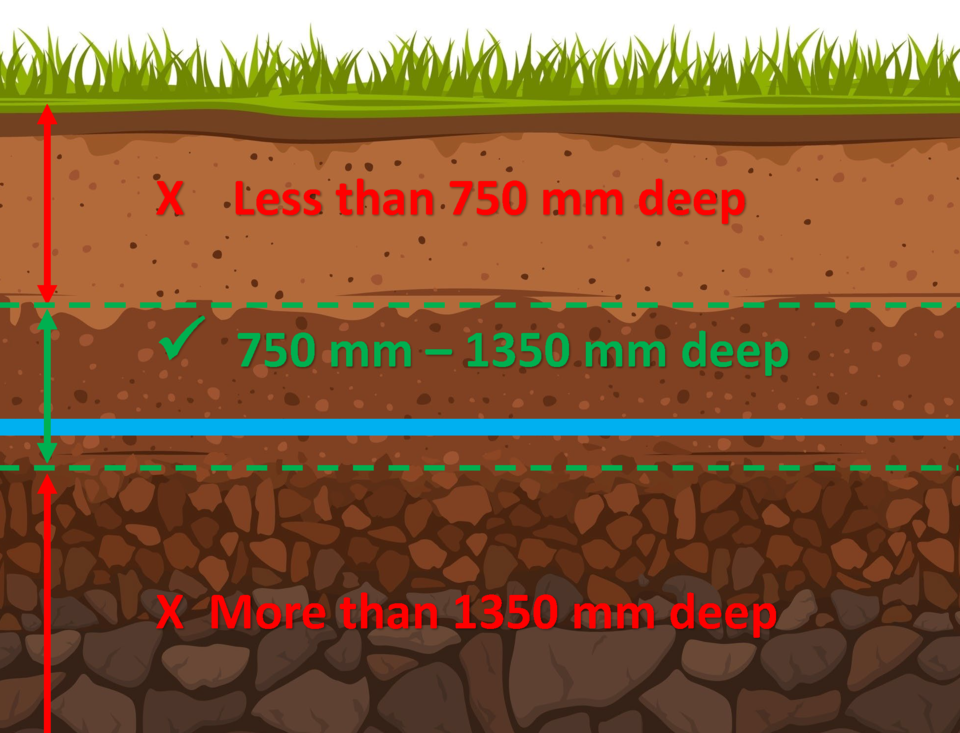
Pipework should be laid at a depth of not less than 750 mm (to limit the effect of freezing and mechanical damage) and no greater than 1350 mm deep. It should be embedded in non-abrasive materials. Where this cannot be achieved in all circumstances the consent of the local water undertakers must be obtained via notification.
Where the local water undertaker consents to pipework being laid at less than 750 mm it should be installed as deep as possible below ground level and protected against warming, freezing and mechanical damage (for example due to ground movement).
Pipework should not be installed above ground level without the agreement of the local water undertaker.
To improve this information please give us your feedback >
Uncontrolled if downloaded. This is informative, non-statutory guidance and intended for general guidance purposes only; it is subject to change.
Compliance with this information should not be relied upon as guaranteeing no enforcement action will be taken by water undertakers. Water Regs UK accepts no liability for loss, indirect or consequential loss arising from or in connection with this guidance document.
To help prevent contamination and waste of mains water supplies the water fittings regulations in England, Wales and Northern Ireland, byelaws in Scotland include specific requirements for water fittings. These include the legal requirement to be of an appropriate quality and standard for installation [regulation/byelaw 4 (1)(a) & 4(2)].
This regulation/byelaw requires water fittings, and water using appliances, to either:
Conform to an appropriate British Standard (or some other national specification which provides an equivalent level of protection and performance)
Or
Conform to a specification approved by the regulators
If the water conveyed by these fittings needs to be wholesome – drinking water standard - any non-metallic materials or components within the fitting or appliance which comes into contact with water must also conform to the current version of BS 6920 (or an equivalent).
Any questions please contact the local water undertaker for advice.
To improve this information please give us your feedback >
Uncontrolled if downloaded. This is informative, non-statutory guidance and intended for general guidance purposes only; it is subject to change.
Compliance with this information should not be relied upon as guaranteeing no enforcement action will be taken by water undertakers. Water Regs UK accepts no liability for loss, indirect or consequential loss arising from or in connection with this guidance document.
This is evidence to show a water fitting is of an appropriate quality and standard for installation.
Water undertakers will consider evidence of compliance provided on a case and site specific basis.
Whilst this evidence must satisfy another regulation/byelaw [4(2)], water undertakers have no preference for, or require it to be in a specific form. Typically, they will consider declarations of performance issued against designated standards, product certification and test reports.
Please note:
Because a water fitting must comply with all parts of the regulations being of an appropriate quality and standard does not, of itself, guarantee compliance with the regulations.
The latest available edition or version of guidance or specifications should always be used.
In respect of equivalence water undertaker retain absolute discretion in assessing whether a national specification provides an equivalent level of protection and performance to that specified in an appropriate British Standard. For information regarding the equivalence of a performance specification please contact your water undertaker.
For further information please refer to Regulation 4(1)(a) compliance guidance and BS 6920 Compliance Overview.
Any questions please contact the local water undertaker for advice.
To improve this information please give us your feedback >
Uncontrolled if downloaded. This is informative, non-statutory guidance and intended for general guidance purposes only; it is subject to change.
Compliance with this information should not be relied upon as guaranteeing no enforcement action will be taken by water undertakers. Water Regs UK accepts no liability for loss, indirect or consequential loss arising from or in connection with this guidance document.
Providing appropriate and adequate backflow protection against the highest level of risk downstream is installed, an installation not used to supply water for drinking, bathing, food preparation or cooking purposes is exempt from complying with schedule 2 paragraph 2(1).
Please note the backflow protection required needs to be assessed by the local water undertaker and other requirements of the water fittings regulations/byelaws continue to apply.
To improve this information please give us your feedback >
Uncontrolled if downloaded. This is informative, non-statutory guidance and intended for general guidance purposes only; it is subject to change.
Compliance with this information should not be relied upon as guaranteeing no enforcement action will be taken by water undertakers. Water Regs UK accepts no liability for loss, indirect or consequential loss arising from or in connection with this guidance document.
When designing a compliant plumbing system a number of factors need to be considered, including but not limited to:
Avoiding the risk of contamination or damage resulting from the environment in which the system is to be installed or due to the design itself.
The required and attainable supply pressure and other operational parameters
User expectations and whether these are achievable
Suitability of water fittings for use
Providing appropriate, adequate backflow protection.
Water efficiency
Limiting waste.
Useful sources of information include BS EN 806 and BS 8558
To improve this information please give us your feedback >
Uncontrolled if downloaded. This is informative, non-statutory guidance and intended for general guidance purposes only; it is subject to change.
Compliance with this information should not be relied upon as guaranteeing no enforcement action will be taken by water undertakers. Water Regs UK accepts no liability for loss, indirect or consequential loss arising from or in connection with this guidance document.
One way is to measure the supply pressure at a tap directly supplied from the mains at a time when there is little demand, such as at night.
Please note:
This will not take into consideration any transient or surge pressures which may be generated within the system. For example water hammer resulting from the rapid closure of a valve within the system.
Water fittings must be able of accommodating 1½ times the maximum operating pressure.
To improve this information please give us your feedback >
Uncontrolled if downloaded. This is informative, non-statutory guidance and intended for general guidance purposes only; it is subject to change.
Compliance with this information should not be relied upon as guaranteeing no enforcement action will be taken by water undertakers. Water Regs UK accepts no liability for loss, indirect or consequential loss arising from or in connection with this guidance document.
To minimise the risk of contamination resulting from microbial growth and wastage due to taps left to run, cold water storage and distribution systems should be designed and installed to maintain a temperature not exceeding 20oC.
Plumbing systems should be designed and installed to ensure there is regular flow through.
To prevent undue warming, it is good practice to insulate both hot and cold water pipework. Unless it is adequately protected water fittings should not be installed where it could be exposed to heat sources, such as other services or sunlight.
For further information please refer to BS EN 806, BS 8558 and HSE Legionella ACOP.
To improve this information please give us your feedback >
Uncontrolled if downloaded. This is informative, non-statutory guidance and intended for general guidance purposes only; it is subject to change.
Compliance with this information should not be relied upon as guaranteeing no enforcement action will be taken by water undertakers. Water Regs UK accepts no liability for loss, indirect or consequential loss arising from or in connection with this guidance document.
Stop valves isolate the supply to premises.
To help minimise waste stop valves should be labelled to indicate what parts of a plumbing system they control.
Stop valves should be installed on the supply pipe in a readily accessible location either inside or immediately outside the premises.
In the case of properties with multiple occupants, such as a block of flats, in addition to the customers own stop tap, a stop valve for maintenance or communal use should be installed.
When selecting a stop valve for use by owner/occupiers consideration should be given to ease and speed of operation, including the effect of sudden changes in supply pressure.
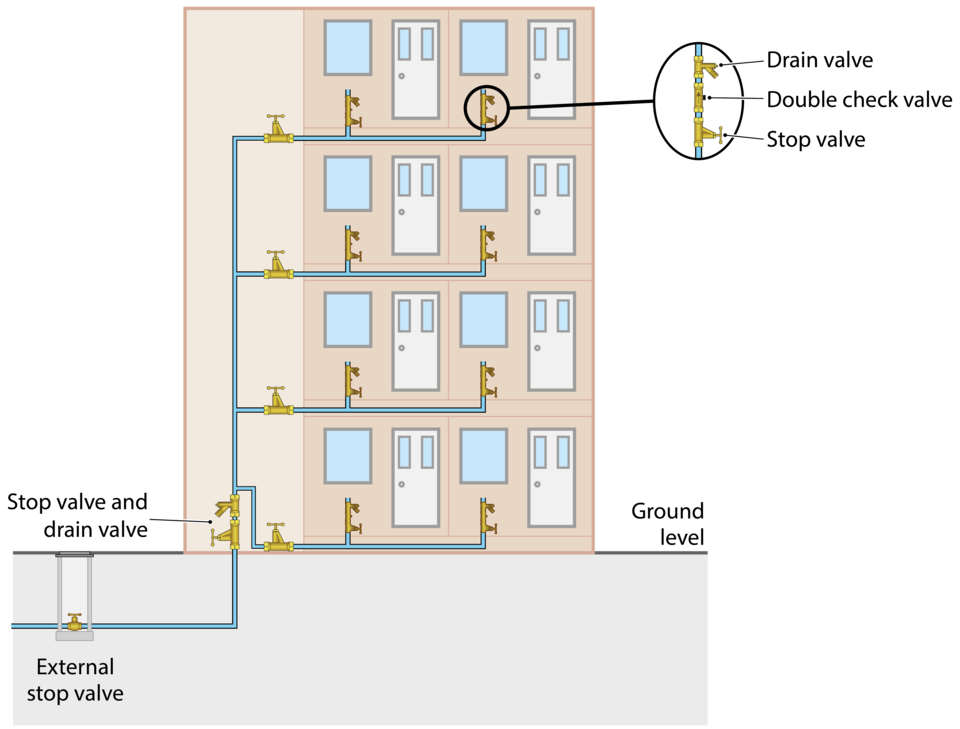
Please note: the illustrations above are examples of acceptable locations for stop valves. Whilst not shown other requirements apply, including but not limited to the installation of drain taps, servicing valves and backflow protection.
For further information contact the local water undertaker.
To improve this information please give us your feedback >
Uncontrolled if downloaded. This is informative, non-statutory guidance and intended for general guidance purposes only; it is subject to change.
Compliance with this information should not be relied upon as guaranteeing no enforcement action will be taken by water undertakers. Water Regs UK accepts no liability for loss, indirect or consequential loss arising from or in connection with this guidance document.
Alternative water supplies should never be directly connected to the mains drinking water and owners/occupiers should always ensure the local water undertaker is aware if a premises has both a mains drinking water and alternative water supply, such as a borehole or rainwater.
Where mains water and other water sources, such as rainwater, recycled water, river water and borehole supplies, combine it is essential to notify the relevant water undertaker to ensure adequate backflow protection arrangements are installed.
The only legal and safe way to combine mains and another source of water is to use an arrangement called a break tank which enables separation of supplies. Typically, this is done using a Type AA or Type AB air gap the key features being:
An unrestricted or weir spill over
The pipework supplying the mains water must be external to the tank
The mains water feed must discharge at a higher level than and maintain a minimum clearance (twice the internal diameter (2D) of the supply pipework or 20 mm whichever is the greater) from those another sources
The water in the tank should not come into contact with the mains water inlet for example as a result of splashing.
To improve this information please give us your feedback >
Uncontrolled if downloaded. This is informative, non-statutory guidance and intended for general guidance purposes only; it is subject to change.
Compliance with this information should not be relied upon as guaranteeing no enforcement action will be taken by water undertakers. Water Regs UK accepts no liability for loss, indirect or consequential loss arising from or in connection with this guidance document.
‘Dead leg’ or ‘blind end’ is a term used to describe a section of pipework (leg) containing water which is not turned over i.e. the water is stagnant (dead). For example, pipework which supplied a system that has been removed or is no longer in use (redundant).
Dead legs should be removed as they are a potential source of contamination. If the dead leg cannot be completely removed any blind end should be as short as possible.
All plumbing systems should be designed to ensure a steady through flow of water. For pipework supplying fittings which are used infrequently i.e. fire supplies or water reuse systems with a back-up supply, appropriate backflow protection should be installed as close as reasonably practicable to the mains or supply/distributing pipe.
To improve this information please give us your feedback >
Uncontrolled if downloaded. This is informative, non-statutory guidance and intended for general guidance purposes only; it is subject to change.
Compliance with this information should not be relied upon as guaranteeing no enforcement action will be taken by water undertakers. Water Regs UK accepts no liability for loss, indirect or consequential loss arising from or in connection with this guidance document.
Yes.
The pressure testing requirements specified in BS EN 806 recommends that plumbing installations and fittings be tested at 1.1 times the maximum working pressure rather than the 1.5 times required by the Water Supply (Water Fittings) Regulations, Byelaws in Scotland.
However due to the terms and definitions applied rather than advocating a lower pressure test than that required by the UK national requirements BS EN 806 actually recommends a slightly higher test pressure. With the result that should an installation be designed to satisfy the pressure test recommendations given in BS EN 806, then it will by default comply with those of the Water Fittings Regulations /Byelaws
Summary of requirements of BS EN 806:
BS EN 806: Part 1 defines maximum design pressure (MDP) of a system as:-
‘the maximum hydrostatic pressure at which the potable water installation is designed to work’
BS EN 806: Part 2 covers design, clause 3.4.2 which covers strength states:-
‘To ensure adequate strength, all components of the system shall be designed to meet the test pressure requirements of the local and national laws and regulations. The test pressure shall be at least 1.5 times the allowable maximum operating pressure (PMA).’
Therefore the maximum design pressure should be at least 1.5 times the maximum operating pressure.
MDP = 1.5 x maximum operating pressure
To comply with the requirements of schedule 2 paragraph 15 (1) a backflow prevention device or arrangement rated to at least fluid category 2 must be installed Fittings Regulations/Byelaws require the system to be pressure tested at:-
1½ x 5 bar =7.5 bar
BS EN 806 recommends a test pressure of:-
1.1 x maximum design pressure (MDP)
where
MDP = 1½ x maximum operating pressure
1.1 x [1½ x 5 bar] = 8.25 bar
To improve this information please give us your feedback >
Uncontrolled if downloaded. This is informative, non-statutory guidance and intended for general guidance purposes only; it is subject to change.
Compliance with this information should not be relied upon as guaranteeing no enforcement action will be taken by water undertakers. Water Regs UK accepts no liability for loss, indirect or consequential loss arising from or in connection with this guidance document.
Yes, appropriate separation is required. Minimising the risk of contaminated fluids coming into contact with water to be used for domestic purposes (drinking, bathing, washing, cooking etc) is a key objective of the water fittings regulations/byelaws.
Mindful of the need to ensure sufficient safeguards are in place to address the possibility of drinking water supplies coming into contact with fluids which are not considered to be wholesome, in determining whether systems making use of heat recovery or exchange are compliant with regulation 4(1) the following factors will be taken into consideration. Please note decisions will be taken on a case by case basis.
The actual fluid categories of the fluids within the system.
How readily identifiable any potential integrity failure of the system would be.
Whether the system design meets the requirements for single or double wall separation specified in BS EN 1717.
To improve this information please give us your feedback >
Uncontrolled if downloaded. This is informative, non-statutory guidance and intended for general guidance purposes only; it is subject to change.
Compliance with this information should not be relied upon as guaranteeing no enforcement action will be taken by water undertakers. Water Regs UK accepts no liability for loss, indirect or consequential loss arising from or in connection with this guidance document.
The method of support and spacing between supports will be dependent on the type of water fitting and material it is constructed from.
In the case of pipework allowance should be made to accommodate likely movement for example thermal expansion and contraction.
Useful sources of information include BS EN 806:4, and BS 8558.
To improve this information please give us your feedback >
Uncontrolled if downloaded. This is informative, non-statutory guidance and intended for general guidance purposes only; it is subject to change.
Compliance with this information should not be relied upon as guaranteeing no enforcement action will be taken by water undertakers. Water Regs UK accepts no liability for loss, indirect or consequential loss arising from or in connection with this guidance document.
Joints on concealed pipework are likely to lose their integrity over time and therefore should only be considered where unavoidable.
To prevent waste there needs to be provision to access any joints or water fittings which require maintenance, such as backflow prevention devices, valves which control the flow and any other operational fitting.
To improve this information please give us your feedback >
Uncontrolled if downloaded. This is informative, non-statutory guidance and intended for general guidance purposes only; it is subject to change.
Compliance with this information should not be relied upon as guaranteeing no enforcement action will be taken by water undertakers. Water Regs UK accepts no liability for loss, indirect or consequential loss arising from or in connection with this guidance document.
All domestic hot and cold water system pipework concealed within walls should:
Be installed with a minimum number of joints. This is because joints are prone to a loss of integrity over time and therefore should only be considered where unavoidable.
Be installed in a chase/duct or void. Wrapping pipework in insulation is not an acceptable method of ducting or passing through a chimney is not an acceptable method of ducting.
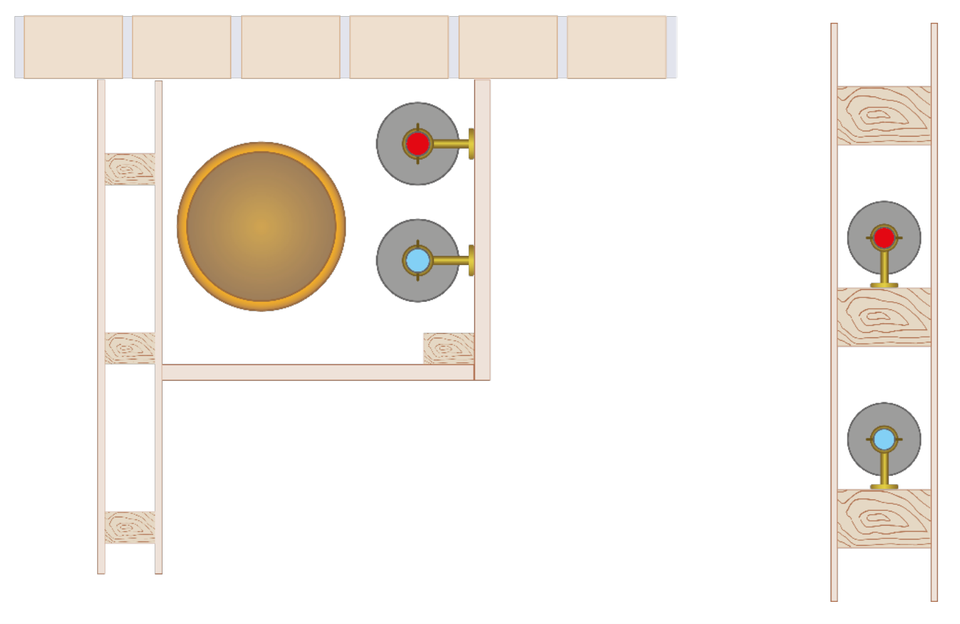
With the agreement of the local water undertaker pipework may be installed alongside other services in a shared duct. An example of what may be considered as acceptable is shown below.
Be appropriately clipped to avoid water hammer and other stresses which would affect the integrity of the installation.
Be insulated with a suitable gap maintained between the cold water, hot water and any other heat source to prevent heat transfer or loss.
Not be embedded or come into contact with other materials such as plaster or cement.
Be accessible to enable inspection and replacement. Further information about accessibility can be found in BS 8558.
Below are images illustrating domestic hot and cold water systems concealed in a wall and a soil pipe duct.
To improve this information please give us your feedback >
Uncontrolled if downloaded. This is informative, non-statutory guidance and intended for general guidance purposes only; it is subject to change.
Compliance with this information should not be relied upon as guaranteeing no enforcement action will be taken by water undertakers. Water Regs UK accepts no liability for loss, indirect or consequential loss arising from or in connection with this guidance document.
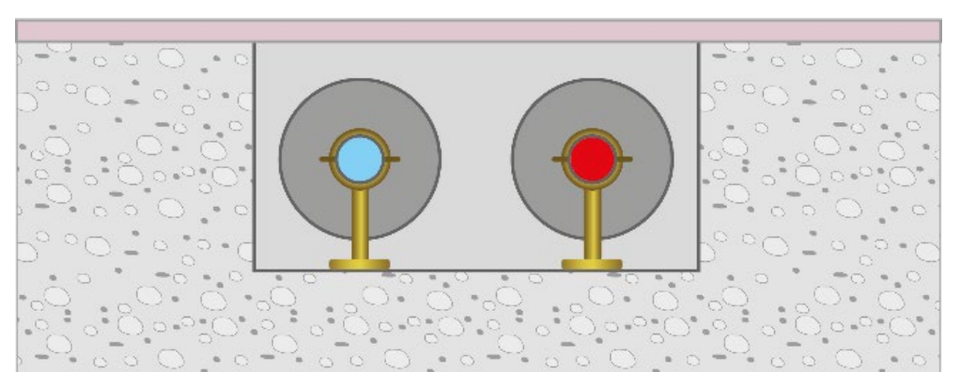
All domestic hot and cold water system pipework concealed within floors should:
Be installed with a minimum number of joints. This is because joints are prone to a loss of integrity over time and therefore should only be considered where unavoidable.
Be installed in a chase/duct or void. Wrapping pipework in insulation is not an acceptable method of ducting.
Be appropriately clipped to avoid water hammer and other stresses which would affect the integrity of the installation.
Be insulated with a suitable gap maintained between the cold water, hot water and any other heat source to prevent heat transfer or loss.
Not embedded or come into contact with other materials such as backfill, screed or cement.
Be accessible to enable inspection and replacement. Further information about accessibility can be found in BS 8558.
To improve this information please give us your feedback >
Uncontrolled if downloaded. This is informative, non-statutory guidance and intended for general guidance purposes only; it is subject to change.
Compliance with this information should not be relied upon as guaranteeing no enforcement action will be taken by water undertakers. Water Regs UK accepts no liability for loss, indirect or consequential loss arising from or in connection with this guidance document.
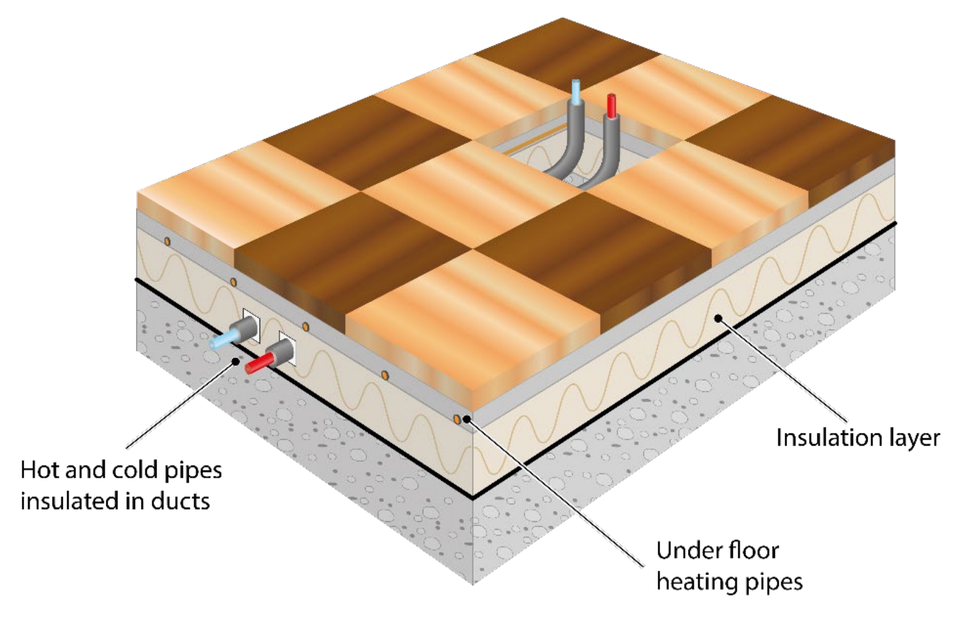
Underfloor heating systems should be installed in a manner considered to be acceptable to building control and the local water undertaker.
If domestic supplies are to be installed in close proximity to underfloor heating, they should:
Be installed as a single run of pipework without any inaccessible joints below the underfloor heating insulation.
To prevent heat transfer or loss any supply pipework should be laid with a suitable gap maintained between the hot and cold systems and both wrapped in insulation.
To improve this information please give us your feedback >
Uncontrolled if downloaded. This is informative, non-statutory guidance and intended for general guidance purposes only; it is subject to change.
Compliance with this information should not be relied upon as guaranteeing no enforcement action will be taken by water undertakers. Water Regs UK accepts no liability for loss, indirect or consequential loss arising from or in connection with this guidance document.
Firstly, the pipe and fittings, including method of connection, should be suitable for below ground use and the environment in which they are to be installed. Joints should be kept to a minimum. Water fittings which are susceptible to permeation by hydrocarbons should not be laid in ground near installation storing or ground contaminated with petrol or oil unless protected.
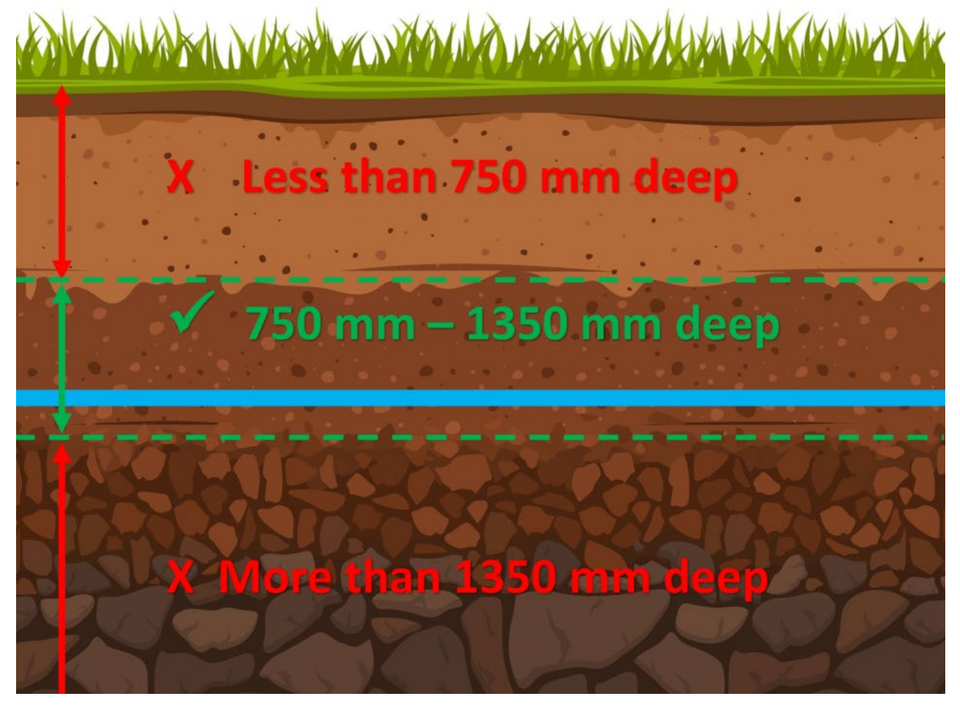
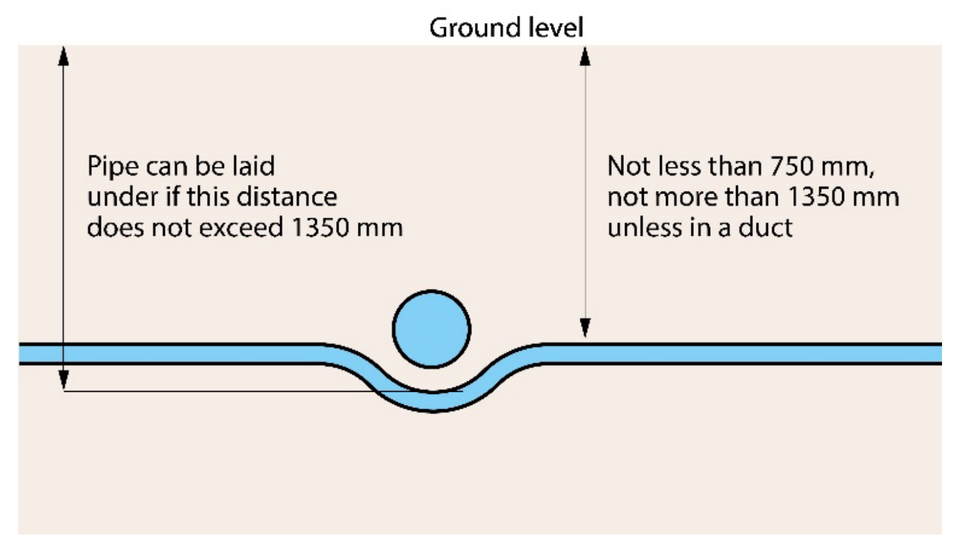
Pipework should be laid at a depth of not less than 750 mm (to limit the effect of freezing and mechanical damage) and no greater than 1350 mm deep. It should be embedded in non-abrasive materials. In all circumstances where this cannot be achieved the consent of the local water undertakers must be obtained via notification.
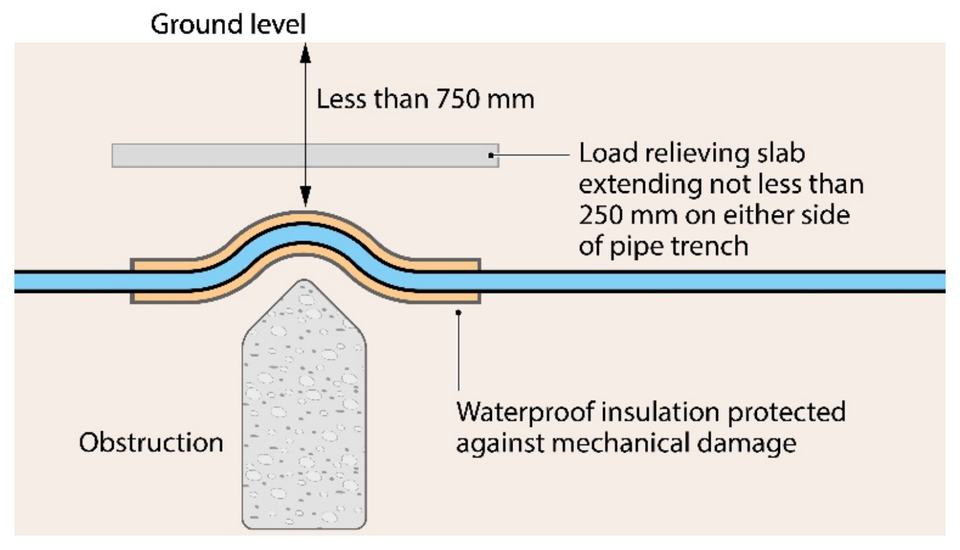
Where the local water undertaker consents to pipework being laid at less than 750 mm it should be installed as deep as possible below ground level and protected against warming, freezing and mechanical damage (for example due to ground movement).
 Examples of how to avoid below ground obstructions are given below. Please note the local water undertaker should be consulted before laying pipework over an obstruction.
Pipework should not be installed above ground level without the agreement of the local water undertaker.
To improve this information please give us your feedback >
Uncontrolled if downloaded. This is informative, non-statutory guidance and intended for general guidance purposes only; it is subject to change.
Compliance with this information should not be relied upon as guaranteeing no enforcement action will be taken by water undertakers. Water Regs UK accepts no liability for loss, indirect or consequential loss arising from or in connection with this guidance document.
Examples of how to avoid below ground obstructions are given below. Please note the local water undertaker should be consulted before laying pipework over an obstruction.
To improve this information please give us your feedback >
Uncontrolled if downloaded. This is informative, non-statutory guidance and intended for general guidance purposes only; it is subject to change.
Compliance with this information should not be relied upon as guaranteeing no enforcement action will be taken by water undertakers. Water Regs UK accepts no liability for loss, indirect or consequential loss arising from or in connection with this guidance document.
Pipework should never be installed in a contaminated environment such as a sewer or cesspool.
Non-metallic (plastic) plumbing fittings are at risk of permeation by diesel or heating fuel, pesticides, insecticides and similar organic substances or fluids, so should never be installed where they could come into direct contact, including contact with soil contaminated with them.
Where this is unavoidable contact the local water undertaker for advice.
To improve this information please give us your feedback >
Uncontrolled if downloaded. This is informative, non-statutory guidance and intended for general guidance purposes only; it is subject to change.
Compliance with this information should not be relied upon as guaranteeing no enforcement action will be taken by water undertakers. Water Regs UK accepts no liability for loss, indirect or consequential loss arising from or in connection with this guidance document.
The recommended distances between utilities can be found in the latest National Joint Utilities Group (NJUG) guidelines. Where these dimensions and depths cannot be achieved protective measures will be required.
Non-metallic water fittings which are susceptible to permeation should not be installed in close proximity to other services for example gas pipelines, or in ground contaminated with hydrocarbons or other contaminants of concern.
If the installation of the pipework is notifiable, under regulation 5 of the water fittings regulations in England, Wales and Northern Ireland, byelaws in Scotland, installation advice should be provided as part of the notification process.
If it is not notifiable there remains a legal obligation for the premises owner or occupier to ensure the plumbing work is fully compliant with the water fittings regulations, byelaws in Scotland.
To improve this information please give us your feedback >
Uncontrolled if downloaded. This is informative, non-statutory guidance and intended for general guidance purposes only; it is subject to change.
Compliance with this information should not be relied upon as guaranteeing no enforcement action will be taken by water undertakers. Water Regs UK accepts no liability for loss, indirect or consequential loss arising from or in connection with this guidance document.
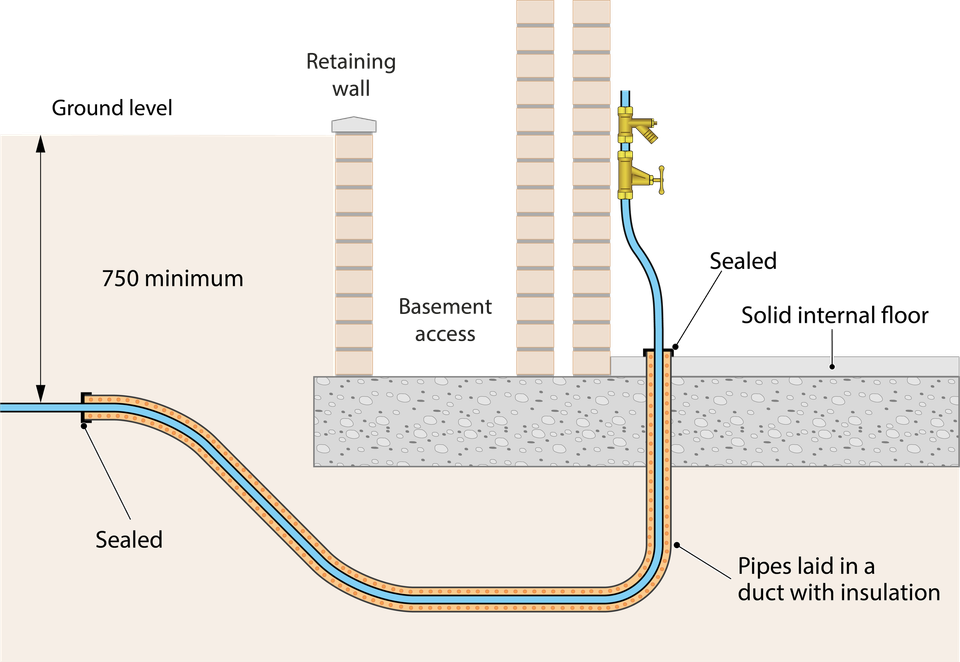
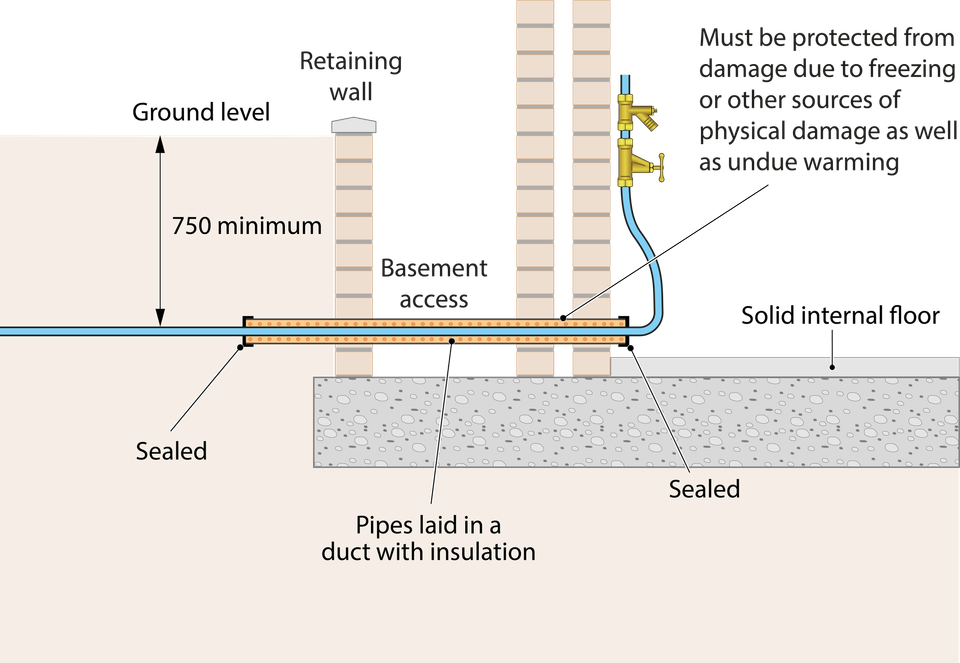
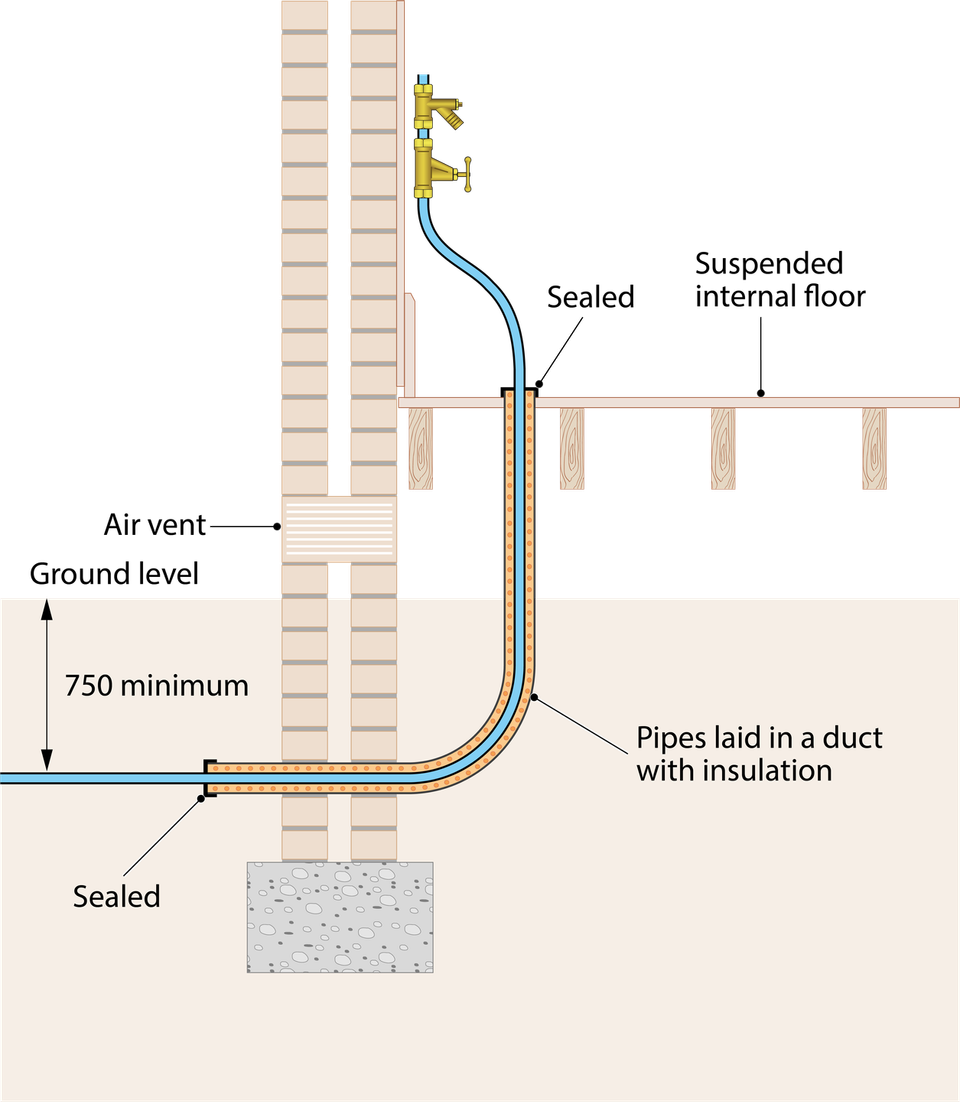
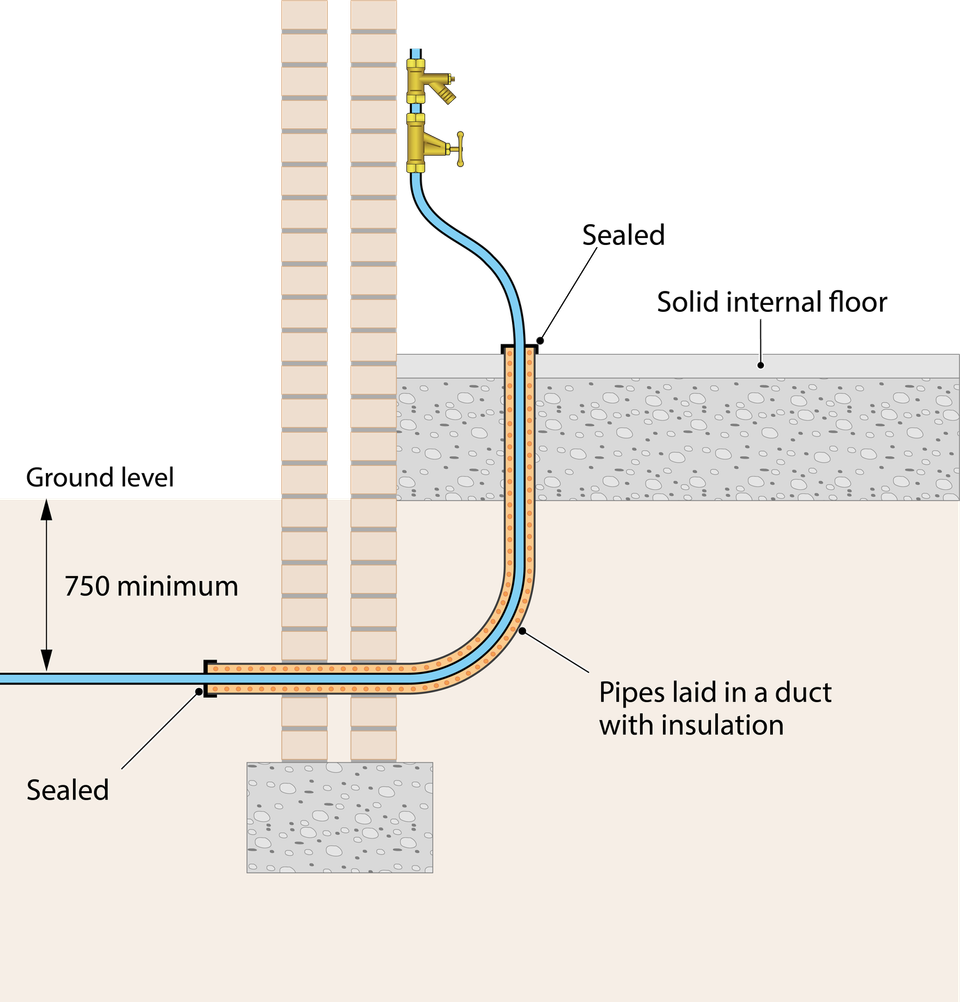
The supply pipe to a building should enter at a depth of 750 mm.
Pipework passing through walls and laid at depths of less than 750 mm, including any inside the building should be ducted. This is to prevent damage, and facilitate ease of replacement, the internal surface of the ducting should be smooth bore i.e. any ridging to be external only.
The pipework should be sealed using a method acceptable to the local water undertaker. This is to prevent ingress of gases and vermin. It should also be adequately insulated. Where pipework is installed below a suspended floor if there is an air vent the pipework should be ducted and insulated to the finished floor level.
The acceptability of the methods of protection for pipework is dependent on a number of location specific factors, such as the type and size of water fitting, the likely water supply and air temperatures as well as demand flow. Manufacturers usually provide information about the appropriate thickness and thermal conductivity in their technical specifications. BS EN ISO 12241 and BS 5422 are another source of useful information.
When installed in accordance with the manufacturer’s instructions insulation may delay but not prevent freezing. Examples of pipework entering a building at and below street level are given below.
To improve this information please give us your feedback >
Uncontrolled if downloaded. This is informative, non-statutory guidance and intended for general guidance purposes only; it is subject to change.
Compliance with this information should not be relied upon as guaranteeing no enforcement action will be taken by water undertakers. Water Regs UK accepts no liability for loss, indirect or consequential loss arising from or in connection with this guidance document.
In addition to the requirements listed in other FAQs, above ground plumbing must be protected against environmental conditions, accidental, mechanical and animal damage.
A regular inspection should be undertaken of pipework and water fittings to identify leaks or other issues. This will help to reduce waste, prevent contamination and save cost.
To improve this information please give us your feedback >
Uncontrolled if downloaded. This is informative, non-statutory guidance and intended for general guidance purposes only; it is subject to change.
Compliance with this information should not be relied upon as guaranteeing no enforcement action will be taken by water undertakers. Water Regs UK accepts no liability for loss, indirect or consequential loss arising from or in connection with this guidance document.
When water freezes it expands, meaning any water fitting subjected to freezing temperatures is at risk of fracturing, causing damage to property and a waste of water. To help prevent this it is essential any plumbing installation which might be exposed to cold conditions, including pipework which is laid shallower than 750 mm deep, are adequately protected. Typically by using insulation materials or trace heating.
Heat gain can also be an issue. Exposure to sunlight and proximity to heat sources can lead to undue warming of cold water, which can often result in taste or water quality issues and customers leaving taps to run. The correct level of insulation should prevent water temperatures exceeding 20°C.
The acceptability of the methods of protection is dependent on a number of location specific factors, such as the type and size of water fitting, the likely water supply and air temperatures as well as demand flow. Manufacturers usually provide information about the appropriate thickness and thermal conductivity in their technical specifications. BS EN ISO 12241 and BS 5422 are another source of useful information.
Any systems not used during cold weather, such as seasonal irrigation systems should be isolated and drained down. Similarly, if a premises is to be left unoccupied and unheated during cold weather, for example a holiday home or caravan, the water supply should be turned off and plumbing system drained.
When installed in accordance with the manufacturer’s instructions insulation may delay but not prevent freezing.
To improve this information please give us your feedback >
Uncontrolled if downloaded. This is informative, non-statutory guidance and intended for general guidance purposes only; it is subject to change.
Compliance with this information should not be relied upon as guaranteeing no enforcement action will be taken by water undertakers. Water Regs UK accepts no liability for loss, indirect or consequential loss arising from or in connection with this guidance document.
To help prevent waste all water fittings must be of an appropriate quality and standard for installation.
Joints are likely to lose their integrity over time and therefore should only be considered where unavoidable.
One of the criteria which must be met, to be considered as being of an acceptable standard, is being capable of withstanding 1½ times the maximum operational pressure a water fitting will be subjected to once installed.
The test methods detailed in Schedule 2 paragraph 12 and BS EN 806 -2, can both be used to demonstrate compliance with this requirement
To improve this information please give us your feedback >
Uncontrolled if downloaded. This is informative, non-statutory guidance and intended for general guidance purposes only; it is subject to change.
Compliance with this information should not be relied upon as guaranteeing no enforcement action will be taken by water undertakers. Water Regs UK accepts no liability for loss, indirect or consequential loss arising from or in connection with this guidance document.
Where contaminants have been identified, and acceptable mitigations made to protect the water supply, following a risk assessment the local water undertaker may agree to pipework being installed in a contaminated environment.
Examples:
Underground pipework should never be installed in a contaminated environment such as culverts, drains or sewerage systems.
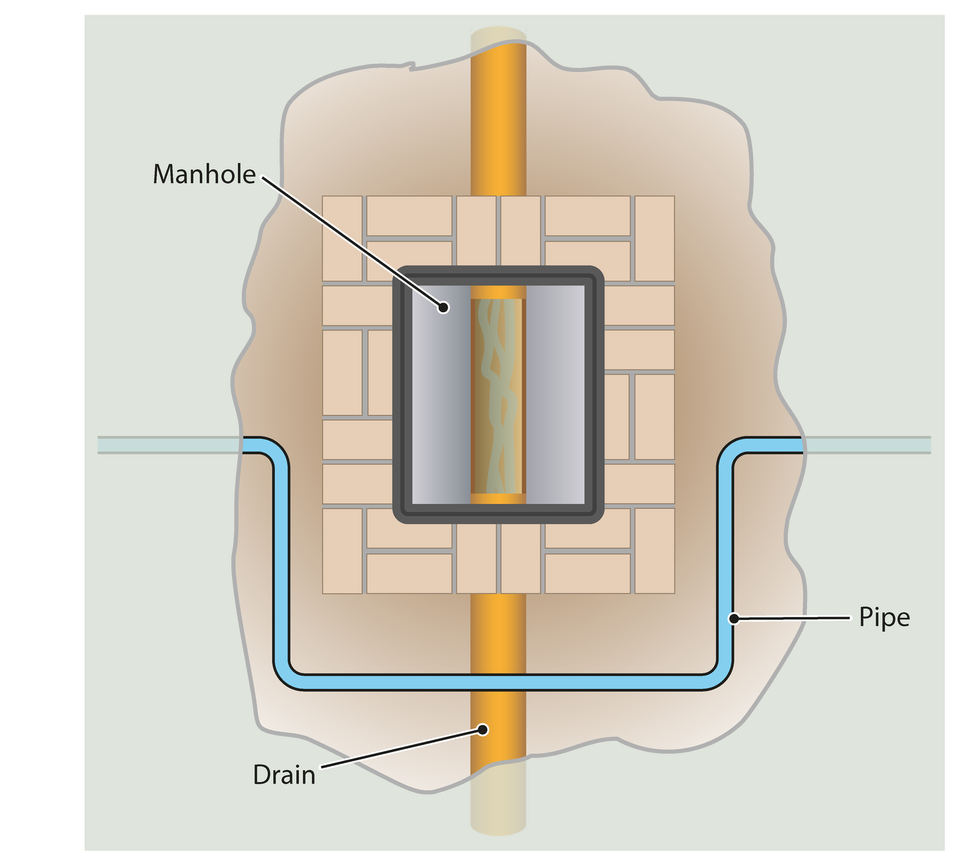
Some water fittings, including those manufactured from non-metallic materials, can be susceptible to damage or permeation if exposed to hydrocarbons, pesticides, insecticides and other sources of contamination. For this reason, they should never be installed where they could come into direct contact with these substances.
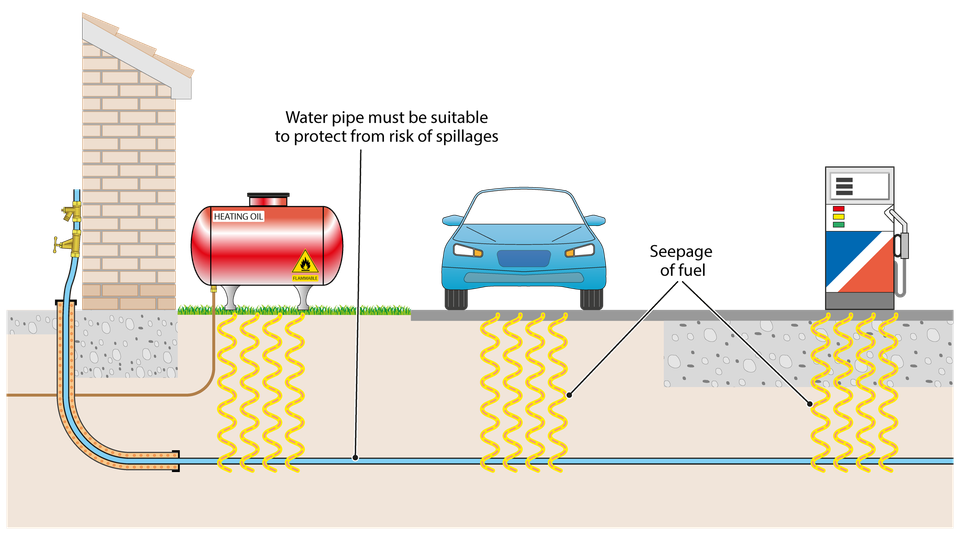
The recommended distances between utilities can be found in the latest National Joint Utilities Group (NJUG) guidelines. Where these dimensions and depths cannot be achieved protective measures will be required.
Above ground pipework should be protected from exposure to corrosive atmospheres, sunlight and other sources of heat gain or loss.
To improve this information please give us your feedback >
Uncontrolled if downloaded. This is informative, non-statutory guidance and intended for general guidance purposes only; it is subject to change.
Compliance with this information should not be relied upon as guaranteeing no enforcement action will be taken by water undertakers. Water Regs UK accepts no liability for loss, indirect or consequential loss arising from or in connection with this guidance document.
To help prevent waste and contamination all pipe and fittings systems must be of an appropriate quality and standard and suitable for the circumstances in which they will be used.
Before installing a pipe and fittings system key considerations will include but are not limited to:
The compatibility of the pipe and fittings. For example, to ensure connections are watertight and configured to prevent galvanic action.
Whether the pipework is to be installed above or below ground
Where the pipework is to be installed. For example, in contaminated ground, in a duct and potentially exposed to construction materials and/or water vapour, somewhere exposed to sunlight or sources of heat.
What water temperatures and pressures the pipework will be exposed to. For example, hot or cold water only, heating systems, maximum operating pressure and thermal shock.
In the case of metallic water fittings, the possibility of corrosion due to galvanic action and dezincification.
Useful sources of information include BS EN 806 and BS 8558
Please note:
All water fittings should be resistant to corrosion. In the case of mechanical backflow prevention devices and metallic fittings which are not going to be readily accessible, in addition to being corrosion resistant these should be manufactured from materials which are not susceptible to dezincification. For example, gunmetal or CR brass.
As non-metallic pipe and fittings can be affected by sunlight and/or allow ingress of light, which is known to promote the growth of algae, consideration should be given to whether protective measures to exclude light are necessary.
Adhesive joints are not acceptable below ground.
To improve this information please give us your feedback >
Uncontrolled if downloaded. This is informative, non-statutory guidance and intended for general guidance purposes only; it is subject to change.
Compliance with this information should not be relied upon as guaranteeing no enforcement action will be taken by water undertakers. Water Regs UK accepts no liability for loss, indirect or consequential loss arising from or in connection with this guidance document.
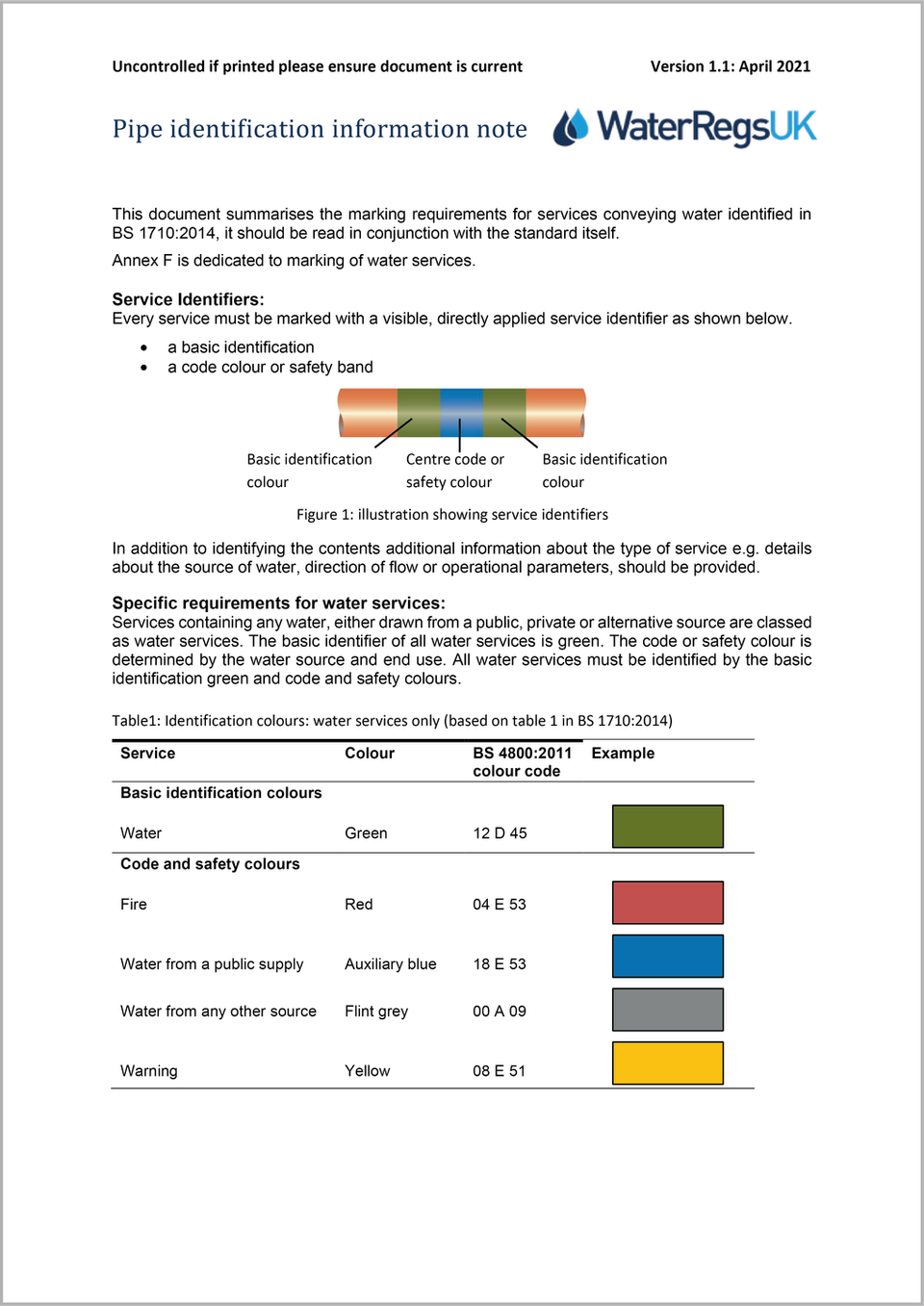
Irrespective of what fluid is being conveyed all pipework, whether installed above or below ground, should be marked in accordance with the latest version of BS 1710.
To identify what parts of a plumbing system they control, servicing valves should be labelled.
For further information please refer to the pipe identification information leaflet
To improve this information please give us your feedback >
Uncontrolled if downloaded. This is informative, non-statutory guidance and intended for general guidance purposes only; it is subject to change.
Compliance with this information should not be relied upon as guaranteeing no enforcement action will be taken by water undertakers. Water Regs UK accepts no liability for loss, indirect or consequential loss arising from or in connection with this guidance document.
To prevent waste there needs to be provision to access any joints or water fittings which require maintenance, such as backflow prevention devices, valves which control the flow and any other operational fitting.
Joints on concealed pipework are likely to lose their integrity over time and therefore should only be considered where unavoidable.
Water fittings installed below or embedded in floors and installed in or behind wall finishes are considered to be concealed. Water fittings installed below ground, but not buried, such as in a chamber or basement room, or installed below floors or in walls, but which can be readily accessed, are not considered to be concealed.
All domestic hot and cold water system pipework concealed within walls should:
Be installed with a minimum number of joints. This is because joints are prone to a loss of integrity over time and therefore should only be considered where unavoidable.
Be installed in a chase/duct or void. Wrapping pipework in insulation is not an acceptable method of ducting or passing through a chimney is not an acceptable method of ducting.
With the agreement of the local water undertaker pipework may be installed alongside other services in a shared duct. An example of what may be considered as acceptable is shown below.
Be appropriately clipped to avoid water hammer and other stresses which would affect the integrity of the installation.
Be insulated with a suitable distance maintained between the cold water, hot water and any other heat source to prevent heat transfer or loss.
Not be embedded or come into contact with other materials such as plaster or cement.
Be accessible to enable inspection and replacement. Further information about accessibility can be found in BS 8558.
Below are images illustrating domestic hot and cold water systems concealed in a wall and a soil pipe duct.
All domestic hot and cold water system pipework concealed within floors should:
Be installed with a minimum number of joints. This is because joints are prone to a loss of integrity over time and therefore should only be considered where unavoidable.
Be installed in a chase/duct or void. Wrapping pipework in insulation is not an acceptable method of ducting.
Be appropriately clipped to avoid water hammer and other stresses which would affect the integrity of the installation.
Be insulated with a suitable distance maintained between the cold water, hot water and any other heat source to prevent heat transfer or loss.
Not embedded or come into contact with other materials which could affect the integrity of the pipework system, such as backfill, screed or cement.
Be accessible to enable inspection and replacement. Further information about accessibility can be found in BS 8558.
Underfloor heating systems should be installed in a manner considered to be acceptable to building control and the local water undertaker.
If domestic supplies are to be installed in close proximity to underfloor heating, they should:
Be installed as a single run of pipework without any inaccessible joints below the underfloor heating insulation.
To prevent heat transfer or loss any supply pipework should be laid with a suitable gap maintained between the hot and cold systems and both wrapped in insulation.
To improve this information please give us your feedback >
Uncontrolled if downloaded. This is informative, non-statutory guidance and intended for general guidance purposes only; it is subject to change.
Compliance with this information should not be relied upon as guaranteeing no enforcement action will be taken by water undertakers. Water Regs UK accepts no liability for loss, indirect or consequential loss arising from or in connection with this guidance document.
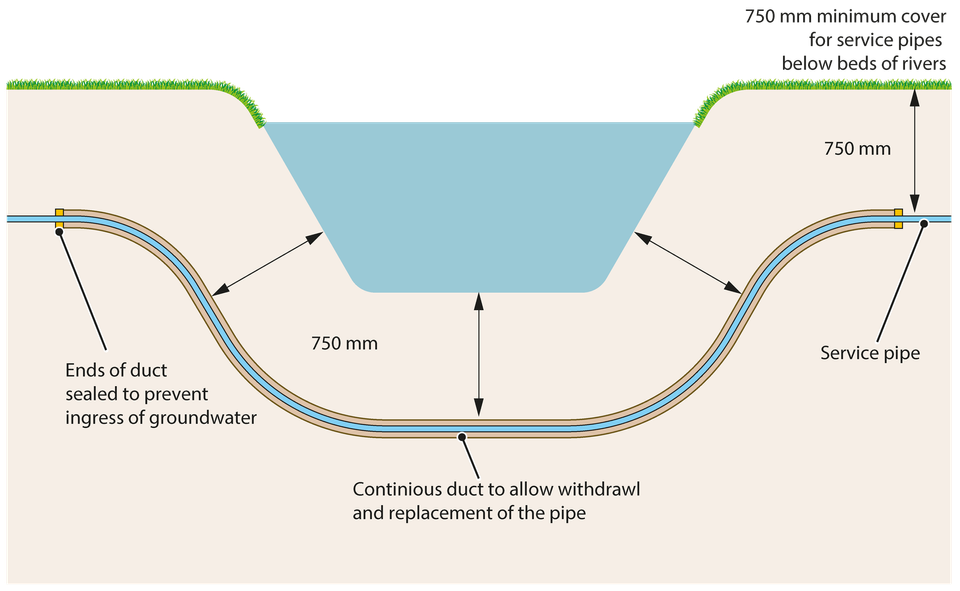
Sometimes pipework will need to cross a natural or manmade water course such as a stream or ditch. Where this is necessary an example of one method of installation, which a water undertaker may be willing to agree to is shown below.
To improve this information please give us your feedback >
Uncontrolled if downloaded. This is informative, non-statutory guidance and intended for general guidance purposes only; it is subject to change.
Compliance with this information should not be relied upon as guaranteeing no enforcement action will be taken by water undertakers. Water Regs UK accepts no liability for loss, indirect or consequential loss arising from or in connection with this guidance document.
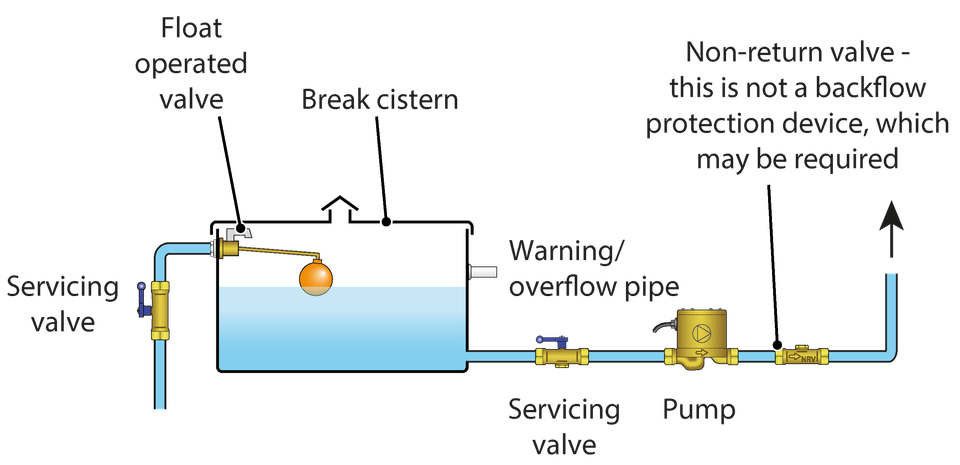
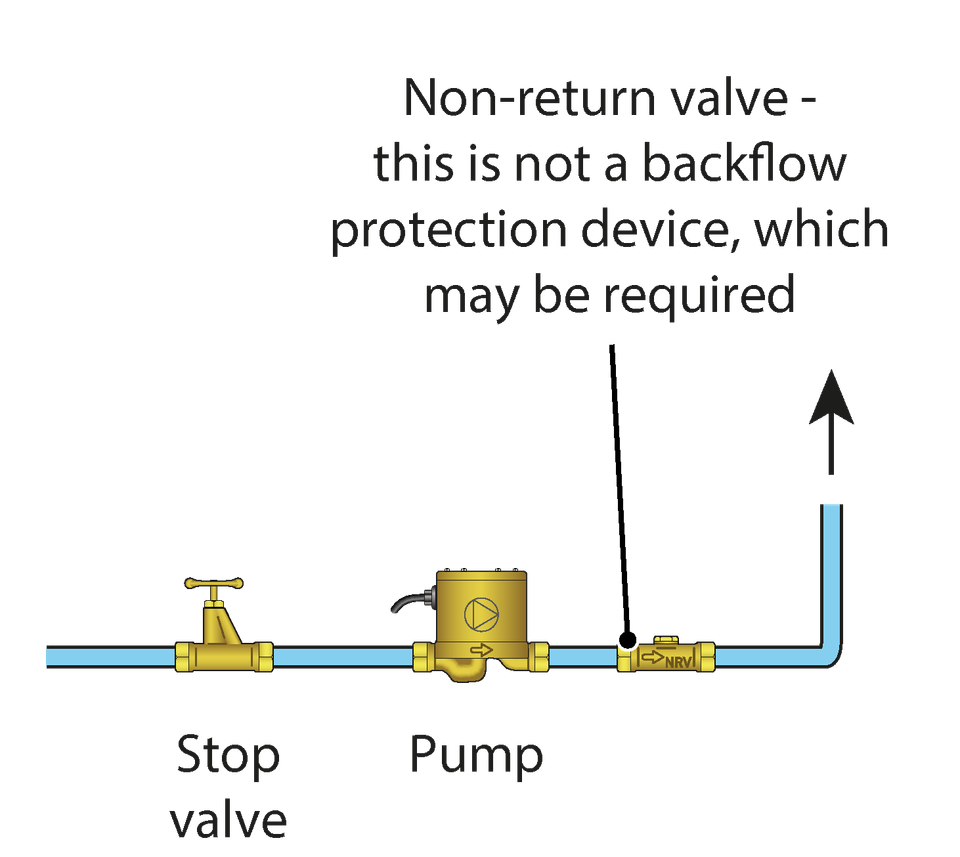
If a pump induces a demand exceeding 12 litres per minute is to be installed the local water undertaker must be notified.
This applies irrespective of whether the pump is connected directly or indirectly to a supply pipe.
To improve this information please give us your feedback >
Uncontrolled if downloaded. This is informative, non-statutory guidance and intended for general guidance purposes only; it is subject to change.
Compliance with this information should not be relied upon as guaranteeing no enforcement action will be taken by water undertakers. Water Regs UK accepts no liability for loss, indirect or consequential loss arising from or in connection with this guidance document.
We use cookies to give you the best possible experience with Water Regs UK. Some are essential to provide website functions and ensure the website is secure. We also use cookies to help us understand how people use the site and to make improvements. Click "Accept All" to enable recommended settings or click "Manage cookies" to adjust your settings. For more details, see our Cookie Policy.